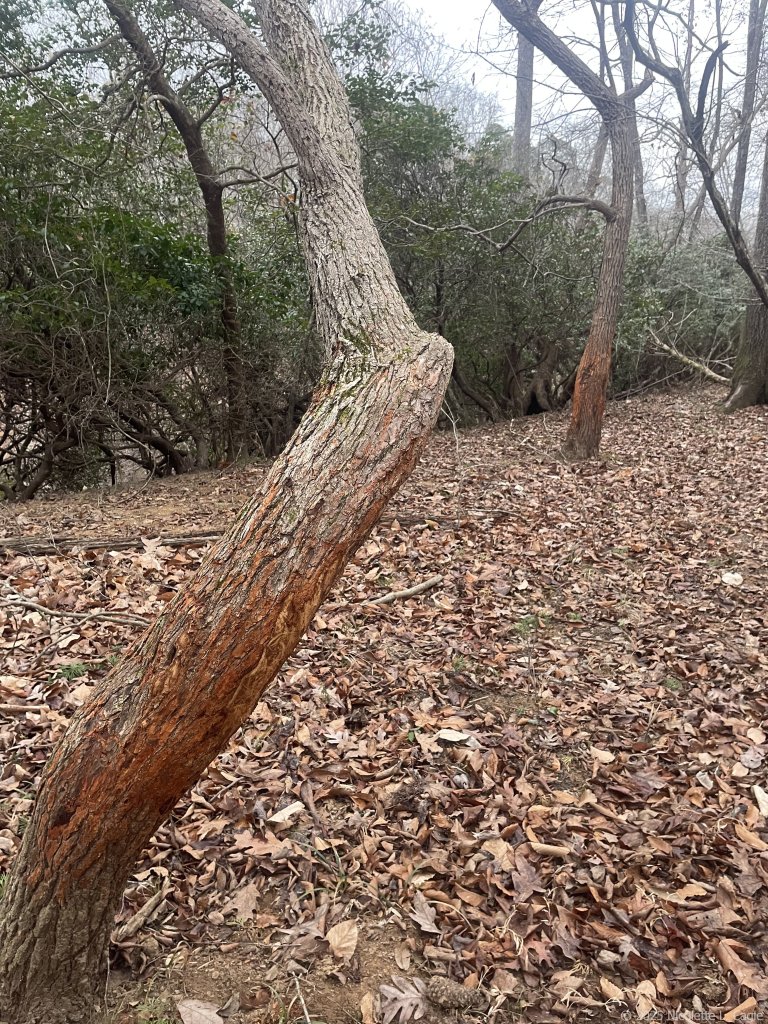
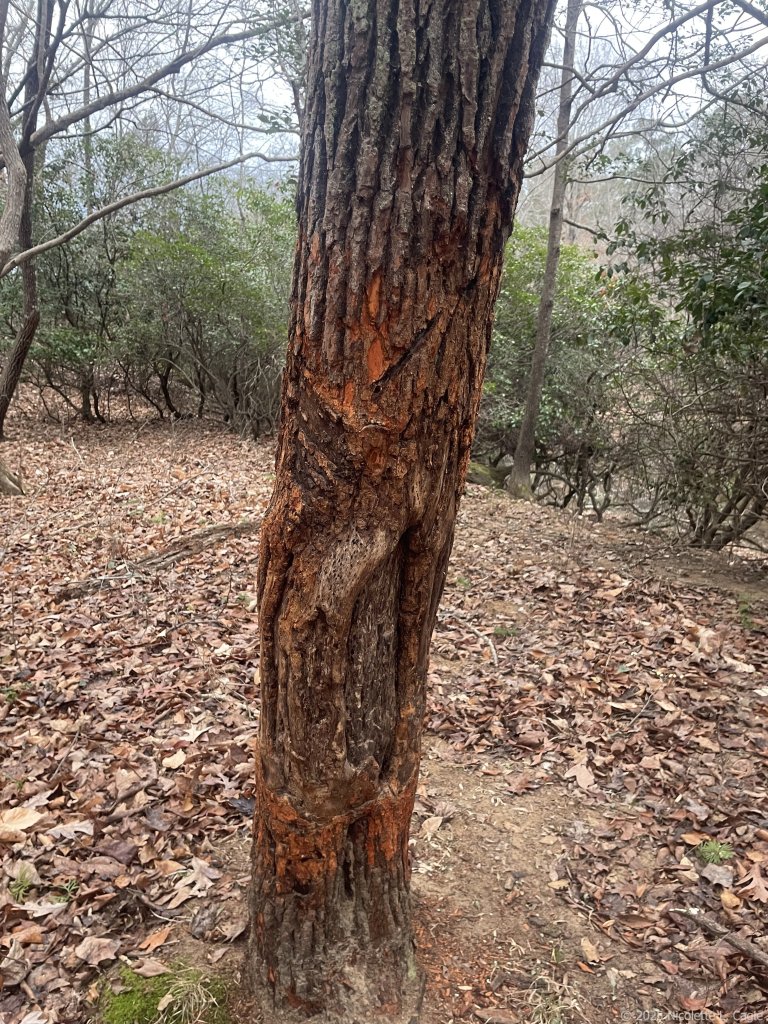
On Monday morning, I went for a walk through the riparian woods along the Eno River. On this familiar route, I noticed two trees rubbed raw, rufous-hued, wounded down to the cambium layer. These rubs are from deer, when a buck scrapes his antlers against tree trunks, creating signposts in time and space to mark the breeding season.
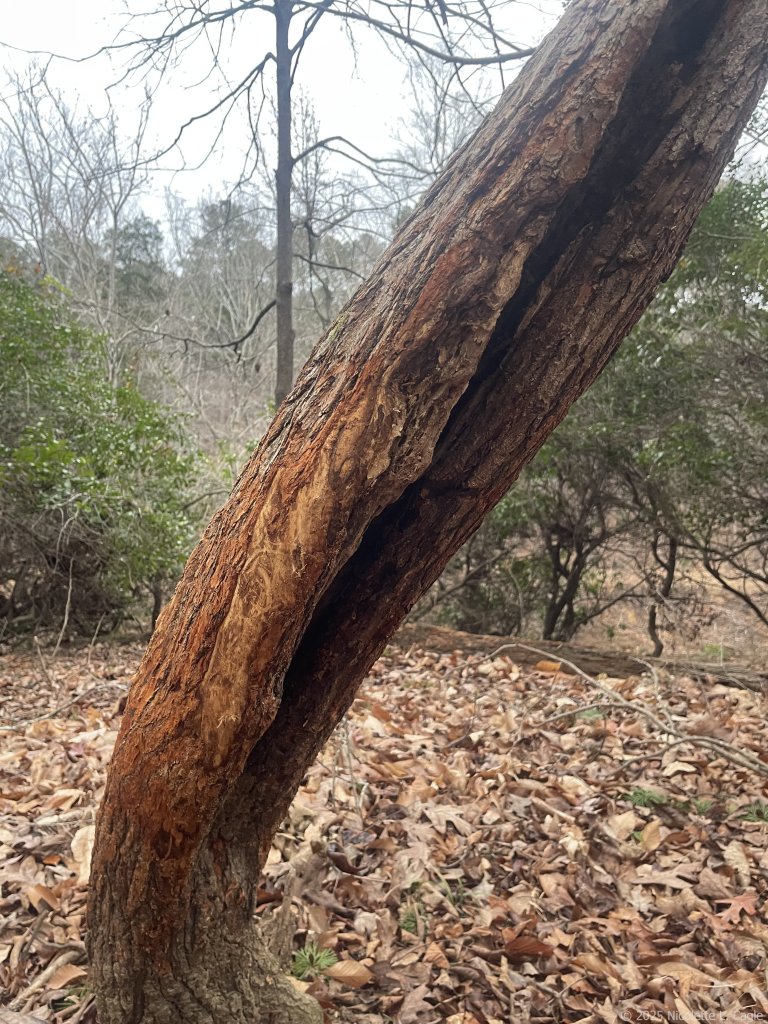
Timing. Deer rubbing activity generally happens twice a year: during the transition to hard antlers and during the rut. The former occurs during late summer and fall, when velvety antlers dry, slough, and mineralize. The rubbing helps remove the velvet and polish the hardening antlers. This often happens in mid-September or October locally.
Importantly, rubbing activity tends to be most intense before and during the rut. Thus, one can approximate how long it had been since I walked that particular path based on the fact that I had only noticed the wounds on December 29. In the Orange and Durham Counties in North Carolina, the average conception date for does in 2025 was November 9 and 13 respectively. This figure is a bit earlier in the Coastal Plain of North Carolina (about October 31 in the Southeast and November 8 in the Northeast) and a little later in the Mountains (early December). This indicates that it has been a couple of months since I last walked that particular path.
Location. Research indicates that the location of these “signposts” aren’t random. The rubs I saw were clustered, on two close trees along a deer trail. This aligns with research that suggests that rubs are often found close together along movement corridors or in other areas that might be ecologically or socially important. Rubs also tend to be found along edges and ecotones (i.e., where two ecosystem types meet), near pinch points, like creek crossings, and at territory boundaries.
In addition, not all trees are selected for buck signposts. Bucks prefer smaller-diameter trees with smooth bark, and some sources indicate that aromatic tree species (like Eastern Red-cedar and Sassafras) are chosen because they release volatile compounds that could help make their rubs more detectable.
Purpose. Buck rubs aren’t just a means of removing velvet or preparing physically for the rut. Rubs also serve as a form of chemical communication. When bucks rub on trees, they rub their antlers, foreheads, and faces. Deer have specialized glands on their foreheads and its likely that they are leaving behind a chemical signal of their identity and reproductive condition. These glands are active seasonally, with activity being moderate in females and very high in males during the rut. Gland activity is even higher in dominant bucks.
This communication is also visual. Buck rubs are photoluminescent. Based on our knowledge of white-tailed deer’s vision, researchers believe that the photoluminescent rubs can be seen by deer during low-light crepuscular hours when deer are most active.
References:
Atkeson, T. D., & Marchinton, R. L. (1982). Forehead glands in white tailed deer. Journal of Mammalogy 63(4): 613-617.
Cook, C. & Gray. B. (n.d.) Biology and management of white-tailed deer in Alabama. Alabama Department of Conservation and Natural Resources. https://alabamalandagent.com/wp-content/uploads/2018/09/deerbook.pdf
DeRose-Broeckert, D. R., Hammond, B. R., Castleberry, S. B., and D’Angelo, G. J. (2025). White-tailed deer signpost photoluminescence. Ecol Evol 15(12): e72618. doi: 10.1002/ece3.72618
Kile, T. L., and Marchinton, R. L. (1977). White-tailed deer rubs and scrapes: Spatial, temporal and physical characteristics and social role. The American Midland Naturalist 97(2): 257-266.
Miller, K. V., R. L. Marchinton, and P. B. Bush. (1991). Signpost communication by white-tailed deer: research since Calgary. Applied Animal Behaviour Science, 29(1-4): 195-204.
North Carolina Wildlife Resources Commission. (2025). Estimated Peak Conception Dates. https://www.ncwildlife.gov/media/4373/download?attachment=
Oehler, M., Jenks, J. A., and Bowyer, R. T. (1995). Antler rubs by white-tailed deer: the importance of trees in a prairie environment. Canadian Journal of Zoology 73(7): 1383-1386.
Ozoga, J. (Nov. 25, 2020). Signpost science: What research tells us about buck rubs. Deer and Deer Hunting. https://www.deeranddeerhunting.com/content/articles/signpost-science-what-research-tells-us-about-buck-rubs
 Sense of Place
Leave a comment