When we explore the Piedmont woods, our attention sometimes shifts away from the showy flowers, stately trees, and singing birds to the diminutive mushrooms around us. Many of these mushrooms have key and important associations with the woody plants that so often structure our definitions of ecosystems.
Fungi & Oaks. In the Piedmont, there are a number of fruiting fungi species that are linked with the oaks (Quercus sp.) and other woody plants in the Fagaceae, the plant family that includes oaks, chestnuts, and beeches. For example, Black Trumpets (Craterellus fallax, Cantharellaceae) are often associated with oak and beech trees in our eastern forests, suggesting an ectomycorrhizal mutualism.
Ectomycorrhizal relationships benefit both the fungus and woody plant. The fungus forms a sheath around the roots of the tree and a net, called a Hartig net, between the root and fungal cells. These structures allow the fungus and tree root to exchange water and nutrients. The fungus supplies water, nitrogen, and phosphorus, using its hyphal network to expand the root’s absorptive surface area, while the plant offers up carbon produced from photosynthesis.
Oaks, and sometimes cherries (Prunus spp, Rosaceae) are also associated with Chicken of the Woods (Laetiporus sulphureus & L. cincinnatus, Laetiporaceae). Chicken of the Woods is not an ectomycorrhizal species, instead it acts as a decomposer, breaking down decaying wood. This type of fungus is a saprobe, and it obtains its nutrients by breaking down dead and decaying organic matter, including dying trees. Mira Polishook, from the Triangle Mycology Society, recently shared that Chicken of the Woods that grows from deciduous trees, like oaks, is edible and tasty, but when it grows from pines, it can cause stomach issues. Another fungus in this category, that is also associated with oaks, is Hen of the Woods (AKA maitake, Grifola frondosa, Grifolaceae). This species is a bit more aggressive than Chicken of the Woods, and can also grow on and weaken living trees.

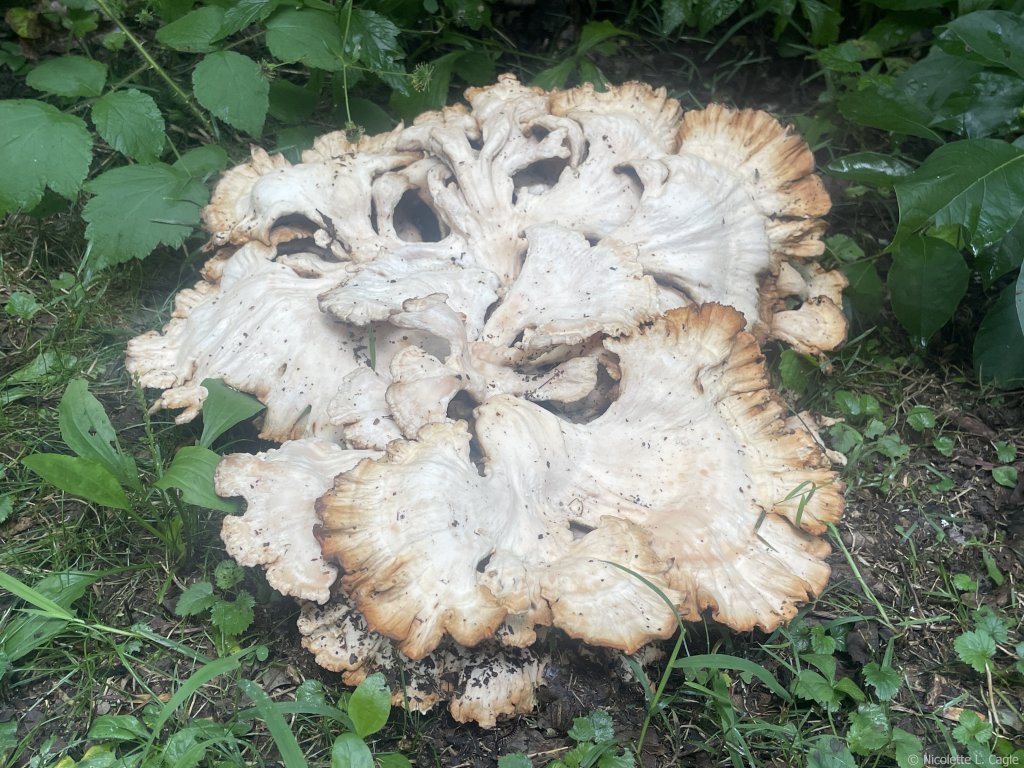
Weeping Conks (Pseudoinonotus dryadeus, Hymenochaetaceae) are commonly found at the base of oak trees. This fungus isn’t just saprobic, it’s a parasite! Weeping Conks grow on living trees and create what is known as “white rot,” particularly affecting the roots and butt of the tree. A Weeping Conk infection stunts tree growth, causes limbs to die, and eventually, kills trees.
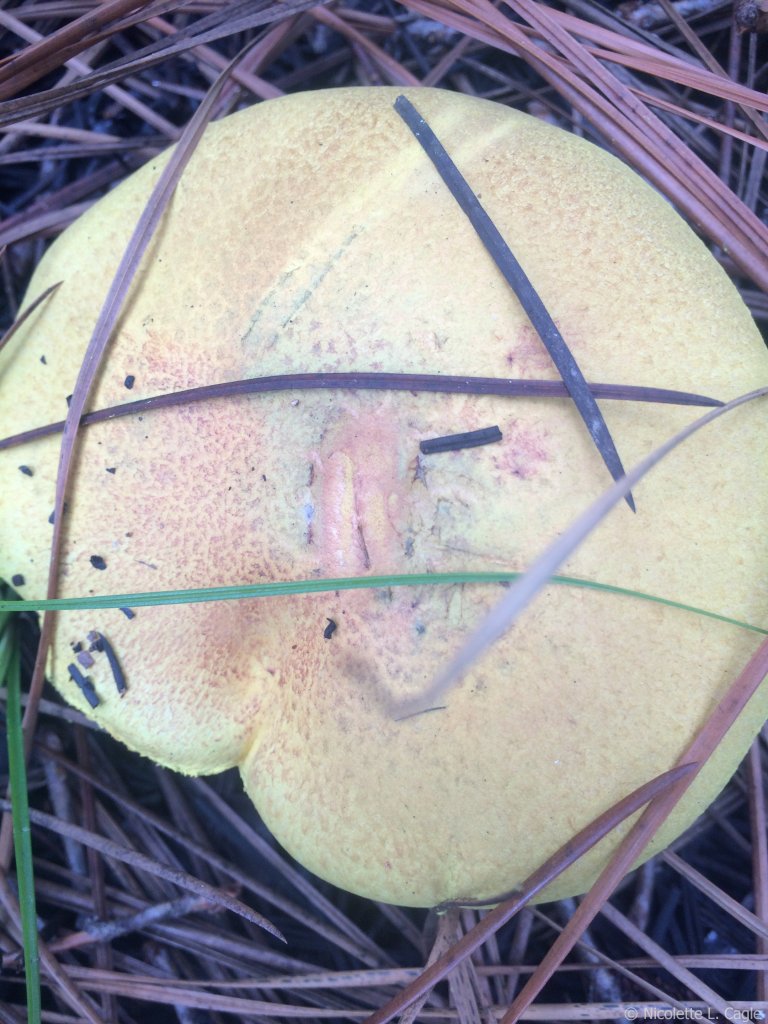
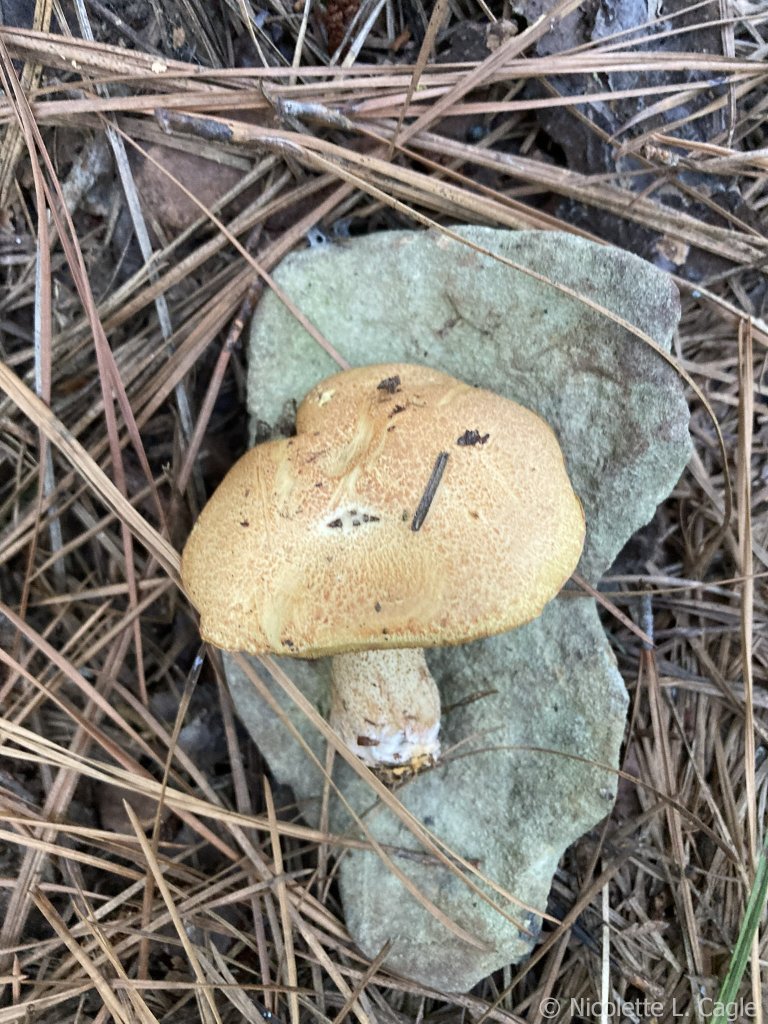
Fungi & Pines. Some fungi are particularly associated with the Pine Family (Pinaceae), which includes firs, hemlocks, pines, spruces, and true cedars. For example, Slippery Jacks (Suillus spp., Suillaceae), including Suillus luteus, are known to form ectomycorrhizal mutualisms with pines. In rare places in the Piedmont where you can find White Pines (Pinus strobus), like at the Triangle Land Conservancy’s White Pines Preserve, it is worth looking for the Chicken-fat Bolete (Suillus americanus), which is a documented White Pine associated ectomycorrhizal fungus.
The Hemlock Varnish Shelf (AKA Hemlock Reishi, Ganoderma tsugae, Ganodermataceae) is a parasitic fungus (think: white-rot wood decomposition on a stressed live tree) that is found almost exclusively on Eastern Hemlocks (Tsuga canadensis). Note that some research has been done on Ganoderma tsugae because purported anti-cancer and anti-inflammatory benefits.
Other Fungal-Tree Associations in the Piedmont. Many other Piedmont trees seem to be tied to particular fungi. For example, the Pecan Truffle (Tuber lyonii, Tuberaceae) has an ectomycorrhizal relationship with the Pecan tree (Carya illinoinensis, Juglandaceae), and has been reported in nearby Knoxville, TN and northeast of Atlanta, GA.
Birches (Betula spp.) are linked with Leccinum species, and in Europe there is a clear ectomycorrhizal relationship between birches and the Brown Birch-Bolete (Leccinum scabrum), which has been reported in Greensboro, Chapel Hill, Raleigh, Apex and beyond . The North American Truffle (Tuber mexiusanum, Tuberaceae) is often linked with cottonwoods (Populus deltoides, Salicaceae); the closest report of this is northeast of Chattanooga, TN. Mira Polishook, from the Triangle Mycological Society, recently shared that morels (Morchella spp.) are often associated with Tulip Trees (Liriodendron tulipifera), especially when Mayapples are growing nearby.
I was recently reminded that American Beeches (Fagus grandifolia), also in the Fagaceae with the oaks, have a fascinating relationship with the fungus Scorias spongiosa that is mediated by Beech Blight Aphids (Grylloprociphilus imbricator). These fuzzy aphids, often white and sometimes black, dance in the wind and suck sap from Beech twigs. After digesting the sap, the aphids excrete “honey dew,” and the spongey black fungus, Scorias spongiosa, grows on the honey dew. Research indicates that Scorias spongiosa can clean pollutants from the air, including heavy metals and polycyclic aromatic hydrocarbons.
American Beeches also have ectomyccorhizal fungal partners, including Lactarius and Russula species. In Europe, beeches are associated with Lactarius blennius and the Olive Brittlegill (Russula olivacea). In Mexico, at the southern limit of the American Beech’s range, the endangered Fagus grandifolia var. mexicanus is associated with Lactarius rimosellus and Lactarius acatlanensis. Interestingly, in the southeastern United States, a a white, chlorophyll-lacking plant that cannot make its own food, known at the Ghost Pipe (Monotropa uniflora), takes advantage of the Beech’s close relationship with fungal partners by tapping into the fungal network and stealing resources from both the beech and fungus!
References
Jouraeva, V. A., Johnson, D. L., Hassett, J. P., Nowak, D. J., Shipunova, N. A., Barbarossa, D. (2006). Role of sooty mold fungi in accumulation of fine-particle-associated PAHs and metals on deciduous leaves. Environmental Research, 102, 272-82.
Montoya, L., Bandala, V. M., Ramos, A. and Garay-Serrano, E. (2017). The ectomycorrhizae of Lactarius rimosellus and Lactarius acatlanensis with the endangered Fagus grandifolia var. mexicana. Symbiosis, 73; 135-144.
Polishook, M. 17 Jan 2026. pers. comm.
 Sense of Place
Leave a comment