A winter storm approaches. Light flakes of snow dance in the air, and the birds forage and feast, fighting to fill their bellies before snow blankets their food source and enforces a period of fasting. The Ruby-crowned Kinglets are acrobats, flipping and bouncing through the trees. The Cardinals are confident, their size and boldness allowing them to jockey for position on fruit-filled shrubs and at feeders. The White-throated Sparrows and House Finches move through the landscape in small groups, with Carolina Chickadees and Titmice flanking them. As one sorts through the birds of a large, mixed winter flock, flashes of white flit and flick on the landscape: The tail feathers of the Dark-eyed Juncos, in dispersed groups on open ground.
Tail Flashing. Why do the Dark-eyed Juncos draw attention to themselves in this way—announcing their presence with passing peeks at their white outer tail feathers, showing off those snow-hued rectrices intermittently as they peck at the frozen ground in search of food? The answer: Predators. Tail flashing is perception advertisement telling potential predators, like Coopers Hawks, that the junco is aware of its presence. When a flash of white alerts a predator that it is visible, the predator is less likely to charge in and try to take that signaling individual, thus tail flashing serves as a pursuit or predator deterrent. Dark-eyed Juncos can also use their tail movements as a way to tell other birds that they are alert and that there may be threats nearby, this is referred to as an alarm signal.
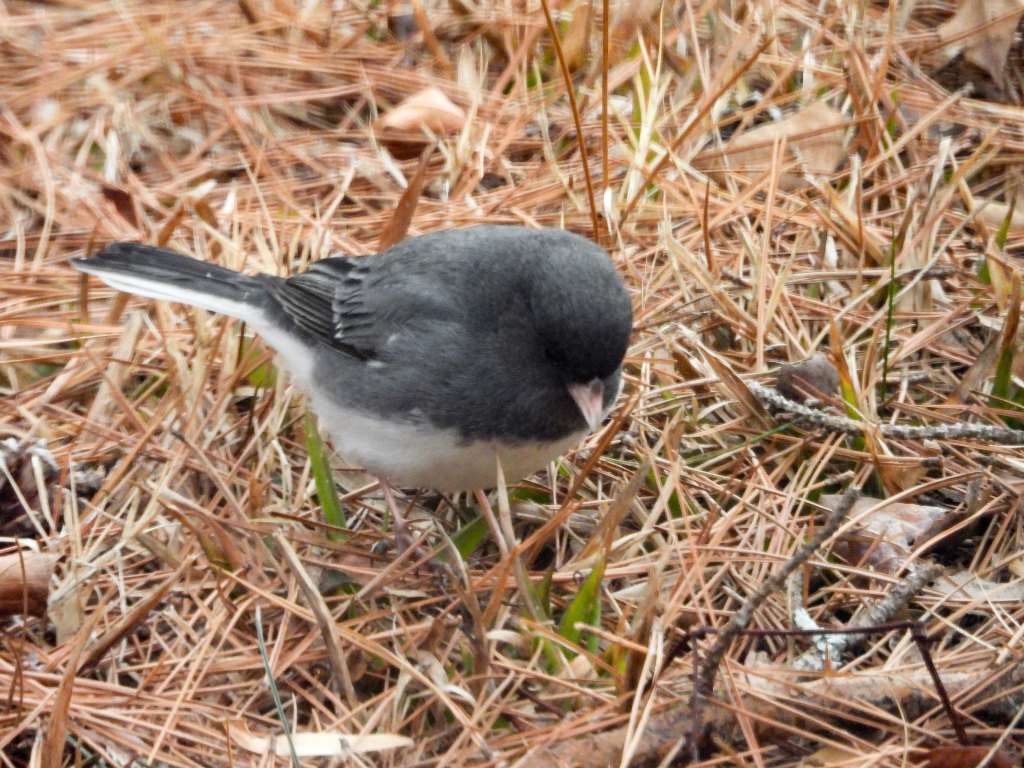
Researchers Divya Ramesh and Steven Lima (2019) have been able to confirm this by setting up a study measuring tail flashing rates of Dark-eyed Juncos in different conditions. For example, tail flashing increased in the presence of a mounted, taxidermied hawk predator, and it also increased when juncos were alone. One nuance of these observations is that tail flashing actually decreased when Dark-eyed Juncos were far from cover. Ramesh and Lima suggest that when there is low probability of escape, the Dark-eyed Juncos opt not to draw too much attention to themselves.
Other species of birds flick (up-and-down movement) and flash (side-to-side spreading) their tails. Researchers suspect that these movements have many different functions including prey flushing (the tail movement may make prey species move), quality advertisement (telling predators that they’re healthy hard-to-catch prey), maintaining flock cohesion, or sharing their own potential quality as a mate.
Dark-eyed Juncos, in particular, are known to tail-flash during the breeding season, and experimental research by Jennifer Hill and colleagues (1999) showed that females “directed more sexual displays” toward males that had their tails “enhanced” with more white feathers. The enhancement process meant cutting off some tail feathers (retrices 3 and 4) and then supergluing white feathers in their stead, eek! The white tail is quite prominent during courtship, when males hop with wings drooped and their tails fanned out, singing in dulcet tones.
Other Seasonal Changes in Juncos. Like other birds that live in North America year-round, Dark-eyed Juncos must adapt to the changing seasons, even when they migrate further south. While some juncos stay in place year-round in parts of the Western United States and the eastern Appalachians, others migrate short (think: Rocky Mountains) and long distances between their breeding grounds in the coniferous forests of Canada and Alaska to their wintering grounds in the southern United States and northern Mexico.
One way that juncos adapt is via seasonal shifts in metabolism and insulation. David Swanson (1991) found that the average body mass of Dark-eyed Juncos in Oregon increased by nearly two grams in winter, as they increased their fat storage and the mass of their contour plumage (i.e., the outermost layer of feathers); the feathers alone improving insulation by nearly 32% in the cold months. In winter, juncos also bump up their metabolic rates and the oxygen-carrying rates of their blood. Notably, Ellen Ketterson and Val Nolan (1976) found that male juncos overwinter farther north than females and tend to be larger than females, and metabolically, can fast about 4% longer (1.6 hrs) than females.
Did you know?
- Juncos are ground-nesters, building cup-shaped nests of moss, rootlets, and forbs in a spot with overhanging roots or grass.
- Young juncos eat partially regurgitated insects, but adults have a diet mostly composed of seeds.
- There are 15 named subspecies of Dark-eyed Juncos (Junco hyemalis L.), sometimes referred to as “races.” These subspecies often have different feather patterns and colors, bill coloration, sizes, and breeding ranges. Some of the subspecies are difficult to differentiate by looks alone, so birders often identify different groups or forms of juncos, e.g., gray-headed, Oregon, pink-backed, red-backed, slate-colored, and white-winged.
References
Hill, J. A., Enstrom, D. A., Ketterson, E. D., Nolan, V., Jr., & Ziegenfus, C. (1999). Mate choice based on static versus dynamic secondary sexual traits in the dark-eyed junco. Behavioral Ecology, 10(1), 91–96.
Ketterson, E. D., & Nolan, V., Jr. (1976). Geographic variation and its climatic correlates in the sex ratio of eastern-wintering Dark-Eyed Juncos (Junco hyemalis hyemalis). Ecology, 57(4), 679–693.
Ramesh, D., & Lima, S. L. (2019). Tail-flashing as an anti-predator signal in small wintering birds. Behavioral Ecology and Sociobiology, 73(5), Article 67. https://doi.org/10.1007/s00265-019-2678-8
Randler, C. (2016). Tail movements in birds—current evidence and new concepts. Ornithological Science, 15(1), 1–14. https://doi.org/10.2326/osj.15.1
Swanson, D. L. (1990). Seasonal variation of vascular oxygen transport in the Dark-Eyed Junco. The Condor, 92(1), 62–66.
Swanson, D. L. (1991). Seasonal adjustments in metabolism and insulation in the Dark-Eyed Junco. The Condor, 93(3), 538–545.
Suggested citation: Cagle, N. L. (2026, January 31). Why does the junco flash its tail and other notes. Sense of Place. https://senseofplace.pub/2026/01/31/why-does-the-junco-flash-its-tail-and-other-notes/
 Sense of Place
Leave a comment