Mountain forests in Central Europe feel layered. Across the Czech uplands and the Western Carpathians, one can move in relatively short distances from foothill broadleaf woods into beech forest, then into colder spruce- and fir-dominated uplands, and finally toward dwarf pine and meadow communities above the tree line. These transitions make the region especially rich for learning how trees respond to geology, snow, wind, and disturbance.
In the Czech Republic, these forests are associated especially with the Bohemian Massif, a geologically old region underlain by Variscan-age igneous and metamorphic rocks, including granite, gneiss, and schist, that have weathered into largely acidic soils. The highest part of this massif is the Sudetes, which border the Czech Republic, Germany, and Poland and include the Jizera, Lusatian, and Hrubý Jeseník Mountains, as well as Śnieżka, their highest peak, at 1,603 m. The region is characterized by steep slopes and high plateaus. History buffs might note that the Sudetes were part of the region known as Sudetenland until the end of World War II, after which the German-speaking population, about three million people, was expelled.

In Slovakia, the Western Carpathians add another layer of complexity: here metamorphic and sedimentary substrates often occur close together, creating contrasts between poor acidic sites and richer, more base-influenced sites. This juxtaposition of substrates supports an unusually rich flora, including many species associated with calcareous bedrock (Jahn 1989).
Much of this mountainous biotic world is structured by altitude. In the foothills and lower slopes, broadleaf trees such as oaks (Quercus), hornbeam (Carpinus betulus), and linden (Tilia spp.) are more common. Higher up, beech forests become increasingly important, often spreading across cooler, moister slopes. In colder and more exposed upper elevations, Norway spruce-dominated stands are common, often joined by silver fir, while dwarf pine and alpine meadow communities help define the area above the tree line. In the Western Carpathians, this sorting is especially clear: foothills around 500–650 m are often broadleaf-dominated, lower mountains are beech-influenced, and upper mountain zones are increasingly coniferous, especially with spruce.
In the Sudetes, vegetation has been described as strongly structured by elevation, with low meadows below about 800 m, old forest between roughly 800 and 1,200 m, and high meadows above 1,200 m. But altitude is only part of the story. Snowpack, wind exposure, avalanches, and past grazing also shape these forests. Research in the Hrubý Jeseník Mountains suggests that reduced traditional grazing, together with possible acidification, has contributed to decreases in subalpine plant diversity, while avalanche disturbance can increase local species richness. These mountain systems are therefore not static; they are dynamic landscapes shaped by both ecological and cultural processes (Jahn 1989; Klinkovská et al. 2023).
People are part of this story as well. In parts of the Sudetes, intensive logging and planting transformed more mixed mountain forests into extensive spruce-dominated stands that now stretch toward the timberline. In the Western Carpathians, too, the present forest pattern reflects not only geology and climate, but also centuries of settlement, land use, and shifting borders. Yet these uplands still contain some of Central Europe’s richest forest habitats, including old-growth remnants and important wildlife corridors for brown bears, wolves, and lynx.
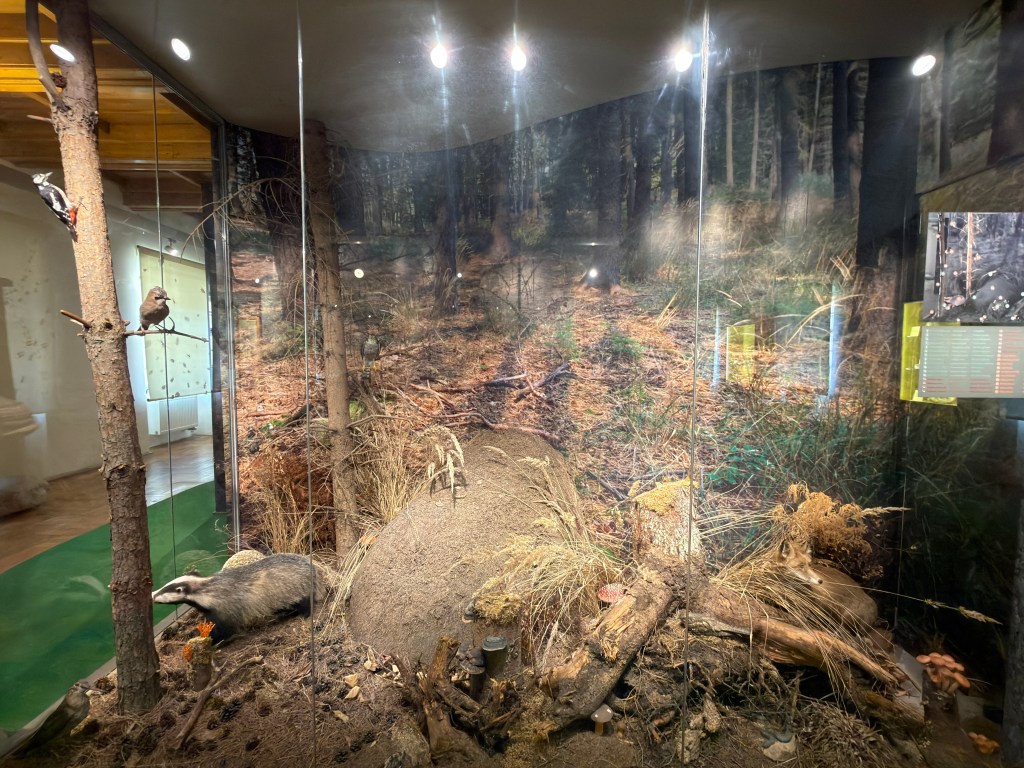
Deadwood also drives diversity in these mountain forests. Fallen trunks, standing snags, and slowly decaying branches create habitat for fungi, insects, cavity-using birds and mammals, and the broader food webs that depend on them. In other words, these forests are structured not only by living trees that dominate the canopy, but also by the long afterlife of wood in decay.
Some of the most characteristic trees of these uplands include Sycamore Maple (Acer pseudoplatanus), European Beech (Fagus sylvatica), Silver Fir (Abies alba), Norway Spruce (Picea abies), and European Larch (Larix decidua). Other woody plants commonly associated with these systems include Mountain Pine (AKA Dwarf Pine, Pinus mugo), Bilberry (Vaccinium myrtillus), Norway Maple (Acer platanoides), and Wych Elm (Ulmus glabra). Together, these species help create the structure and ecological complexity of Central Europe’s mountain forests.
In the posts that follow, I’ll take a closer look at several of these trees, especially European Beech, Norway Spruce, and European Larch. Beech helps define the atmosphere of many upland forests, its deep shade shaping the understory below. Spruce tells a more complicated story: native in colder mountain zones, but also widely planted beyond them. European Larch, by contrast, stands out immediately as the region’s native deciduous conifer, dropping its needles in autumn and often growing in more open, light-filled mountain settings. Together, these species offer different ways of understanding how Central Europe’s uplands work, and how trees help give them their distinct sense of place.
Sources and Further Reading
Jahn A. 1989. The soil creep on slopes in different altitudinal and ecological zones of Sudetes Mountains. Geografiska Annaler: Series A, Physical Geography. 71(3–4):161–170.
Klinkovská K, Kučerová A, Pustková Š, Rohel J, Slachová K, Sobotka V, Szokala D, Danihelka J, Kočí M, Šmerdová E, Chytrý M. 2023. Subalpine vegetation changes in the Eastern Sudetes (1973–2021): Effects of abandonment, conservation management and avalanches. Applied Vegetation Science. 26:e12711.
 Sense of Place
