In the last several posts, I’ve been exploring the mountain forests of Central Europe and some of their characteristic trees — among them Sycamore Maple, European Beech, Silver Fir, Norway Spruce, and European Larch. But much of everyday life in Central Europe takes place below those cooler, steeper uplands.
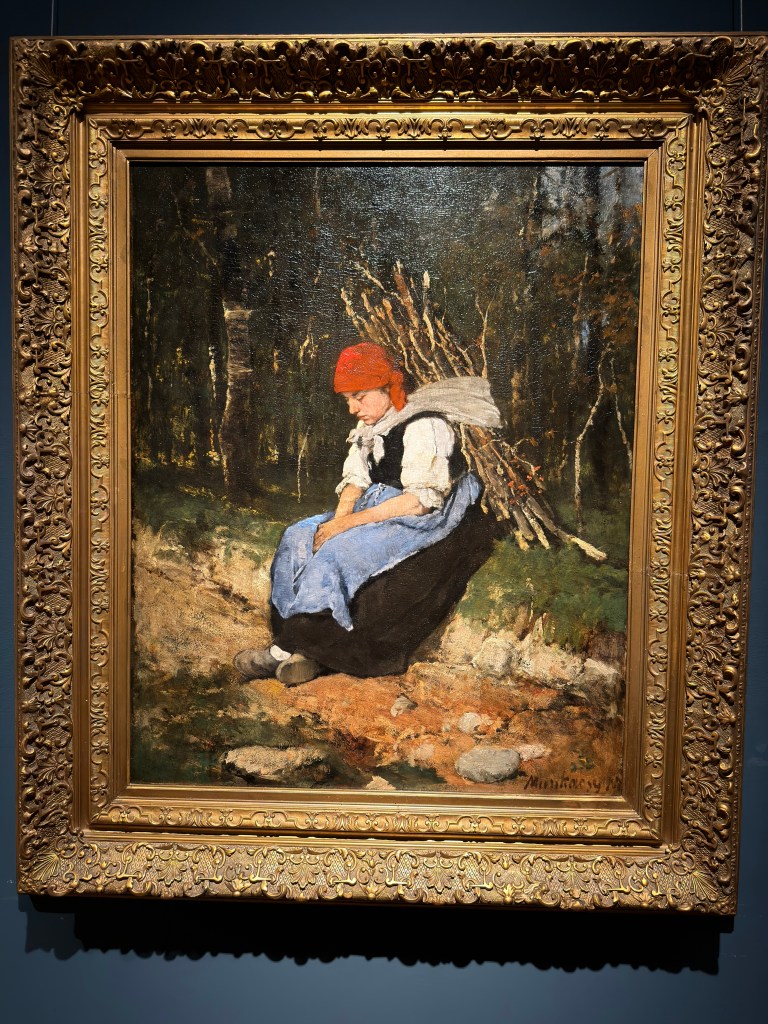
Mihály Munkácsy’s Woman Carrying Brushwood (1873), now in the Hungarian National Gallery, offers a compelling image of forest life below the mountains and helps us visualize the broadleaf forests of Central Europe. The museum signage suggests that the setting is probably the woods of Barbizon, and although that is not the same forest type as the oak-hornbeam-linden woods of Munkácsy’s native Hungary, it evokes a similarly lived-in broadleaf woodland world. The painting has been interpreted as a portrait of exhaustion and hard labor, but the young woman’s face suggests something more meditative. Resting in the forest, she connects us to the intimacy of everyday woodland use: these were not only ecological communities, but places where people gathered fuel, moved through shade, paused in thought, and made their lives alongside trees.
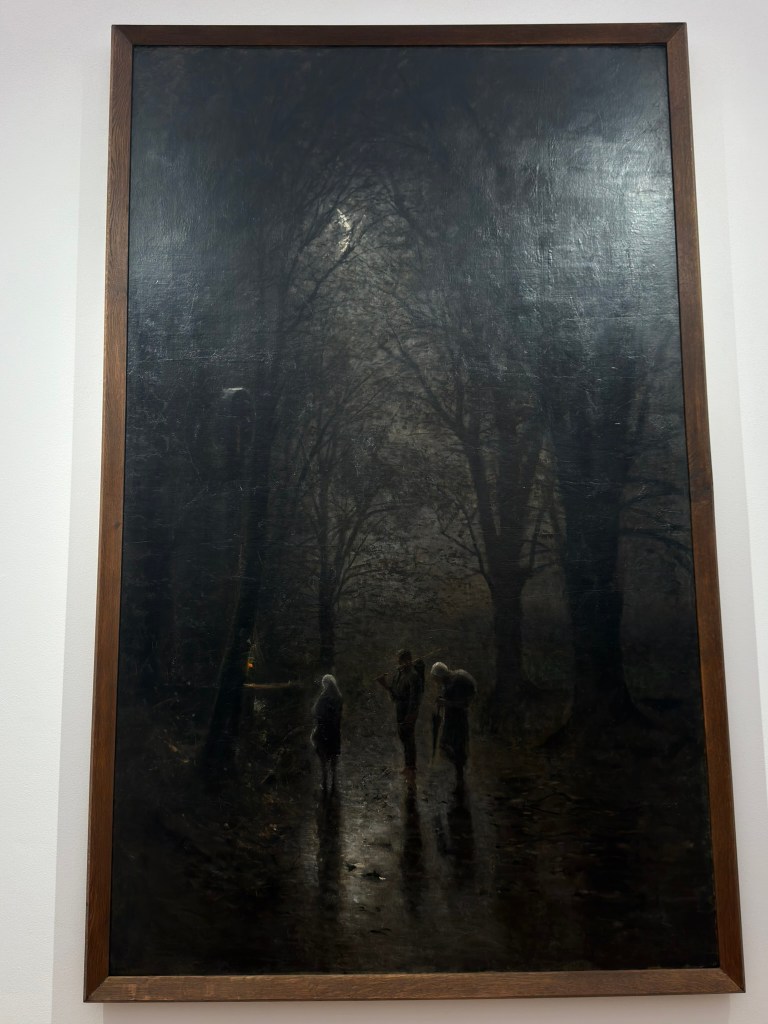
Ladislav Mednyánszky’s Night Travelers at a Cross (Road through the Woods) (1880–1882), in the Slovak National Gallery, offers another vision of this lower forested world. The museum describes the painting as a moonlit road through the woods, with a group of pilgrims praying at a cross in the light of a flickering candle. While Munkácsy’s painting evokes the broadleaf forest as a place of labor and pause, Mednyánszky’s suggests something more shadowed and devotional: the forest as passageway and inward journey. Though more symbolic than ecological, it still helps us imagine these woodlands as lived landscapes through which people travel, work, and make meaning.
Across the Czech Republic, Slovakia, and Hungary, broadleaf forests fill the rolling hills, foothills, parklands, and semi-natural woodlands that lie between mountains, towns, and agricultural land. These are the forests of oak, hornbeam, linden, and maple, that are perhaps less dramatic than the high mountains, but no less important in giving the region its character.
The lowland and foothill forests of Central Europe form part of the day-to-day forest matrix in these countries, often interspersed between settlements and cultivated land. Much of this region is underlain by glacial loess, especially in the Carpathian and Pannonian regions of Hungary, though local conditions vary considerably from one slope or valley to the next.
Within this broad zone, substrate matters. In Hungary, some lowland and hilly forests grade into Oak Woods on lime-rich soils, Rocky Slope Forests, and Forest-Steppe Woods. Field Maple is especially associated with floodplains, forest edges, and Turkey Oak–Sessile Oak Forests; European Hornbeam is common in Oak-Hornbeam and Forest-Steppe Woods; and Little-leaved Linden extends into Oak-Hornbeam Forests, Rocky Slope Forests, and some Beech Forests.
The quintessential temperate broadleaf forest of this region tends to be dominated by oaks, hornbeams, lindens (or limes), and maples. Oaks often dominate the canopy on drier sites, hornbeams commonly serve as co-dominants in the midstory or lower canopy, and lindens and maples become more prevalent on mesic sites with somewhat richer or moister soils.
These are not uniform forests. They shift subtly with soil chemistry, slope, moisture, exposure, and land-use history. A dry, lime-rich hillside may lean toward oak and hornbeam. A cooler or moister slope may draw in linden, maple, or even Bnech. In that sense, these broadleaf forests are a wonderful place to learn not just tree names, but how trees sort themselves across the land.
Some of the key trees of this region include Pedunculate Oak (Quercus robur), Sessile Oak (Quercus petraea), European Hornbeam (Carpinus betulus), and Little-leaf Linden (Tilia cordata). Other woody plants commonly found in these systems include Field Maple (Acer campestre), Broad-leaved Linden (Tilia platyphyllos), Silver Linden (Tilia tomentosa), Tatar Maple (Acer tataricum), and Hawthorn (Crataegus monogyna).
Taken together, these broadleaf forests reveal another side of Central Europe: one shaped more by layered deciduous canopies, fertile and calcareous soils, and long histories of grazing, coppicing, cultivation, and settlement. They are forests of texture and nuance, of shade that is seasonal rather than year-round, and of trees whose ecological roles are intertwined with deep cultural histories.
In the posts to come, I’ll take a closer look at several of the species that anchor this forest world. Next up is Pedunculate Oak, followed by Sessile Oak, European Hornbeam, and Little-leaf Linden, four trees that together help define the structure and meaning of Central Europe’s broadleaf lowlands and foothills.
References
Bartha D. 1999. Magyarország fa- és cserjefajai. Budapest (Hungary): Mezőgazda Publishing House.
Olomouc Town Museum signs. n.d. Habitat/tree interpretation panels. [viewed on site Feb 2026].
Prague Botanical Garden signs. n.d. “Pedunculate oak,” “Sessile oak,” and related interpretive signs. [viewed on site Feb 2026]
 Sense of Place
Leave a comment