In the last several posts, I’ve been moving through the major forest types of Central Europe, from mountain forests of spruce, fir, beech, and larch to the lower, broader-leaved woods of the foothills and plains. Most recently, I turned to the Broadleaf Forests of Central Europe, where oaks, hornbeams, lindens, and maples help shape the day-to-day forest matrix of the Czech Republic, Slovakia, and Hungary. Among these trees, Pedunculate Oak (Quercus robur) stands out as one of the most emblematic. It is a tree of strength, longevity, wildlife value, and deep cultural memory.
PEDUNCULATE OAK (English), dub letní (summer oak, Czech), dub letný (summer oak, Slovak), kocsányos tölgy (stalked oak, Hungarian), Chêne pédonculé (French), dąb (oak, Polish)
Quercus robur, Quercus = beautiful tree (Celtic)/oak (Latin); robur = strong/sturdy (Latin)
Identification: The Pedunculate Oak has lobed leaves, with auriculate (ear-like) lobes near the base and a short petiole. The buds are clustered near the twig tip. The bark is thick and becomes deeply fissured with age. The acorns are held on long stalks, or peduncles, hence the common names in English and Hungarian. Specimens have been known to reach 35 m high and 1 m in diameter. According to Cohen and Siegel (2021), the thirteenth-century replica of the Round Table of King Arthur was made from a slice of a single bole of a large, old Pedunculate Oak.
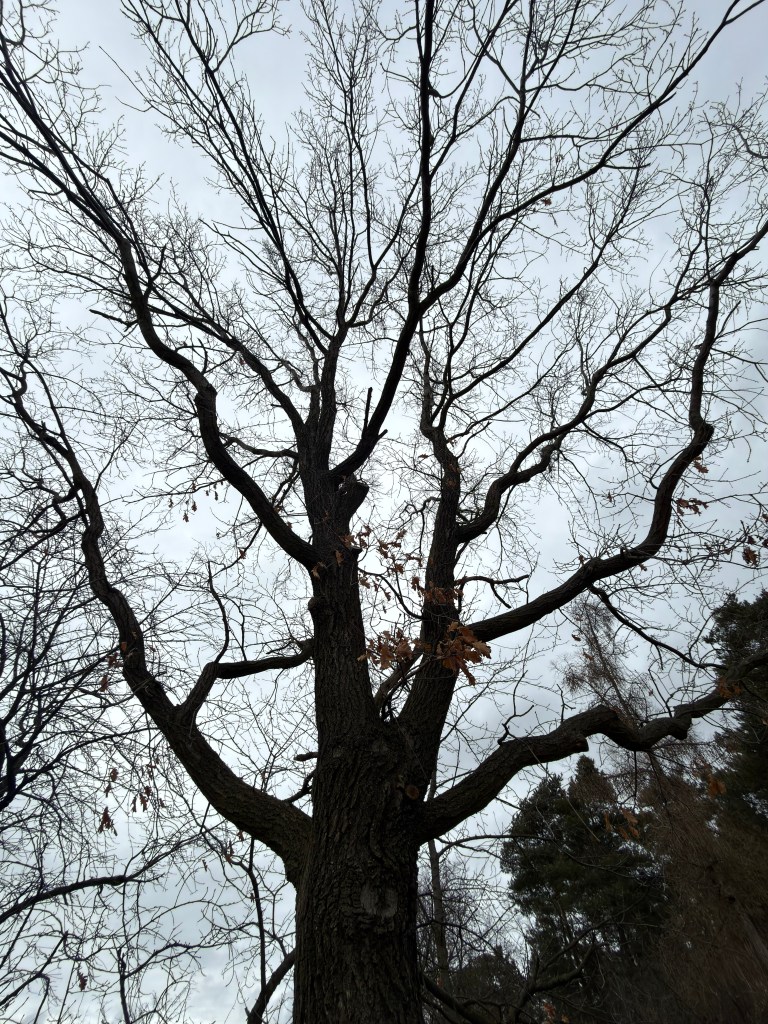
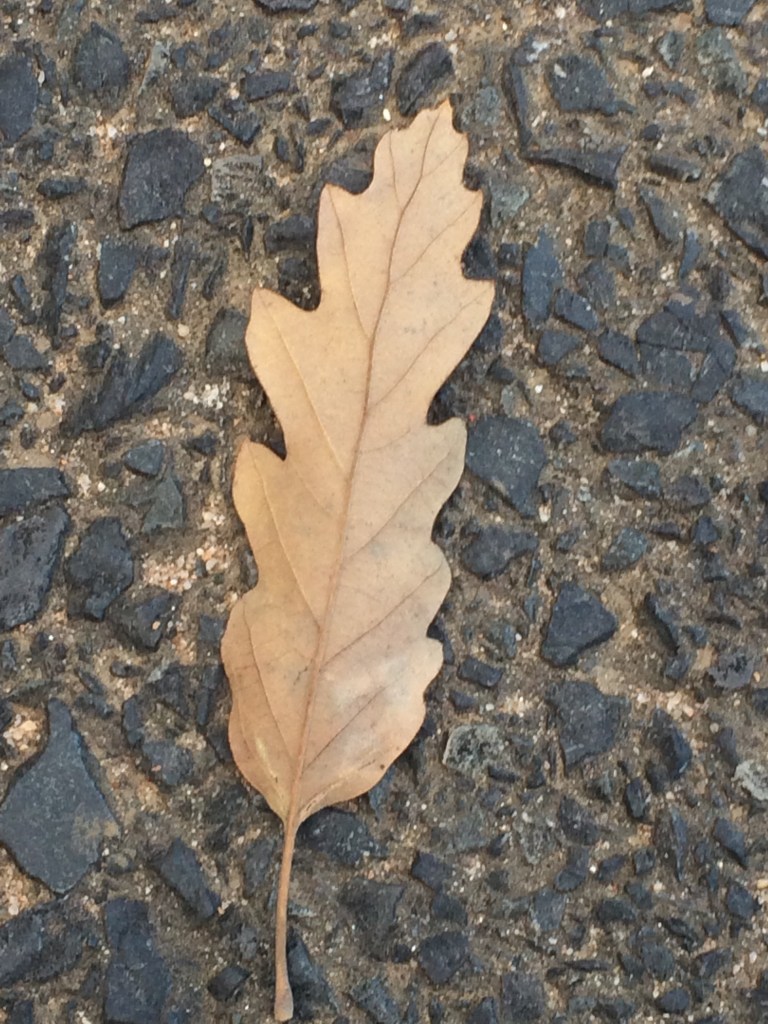
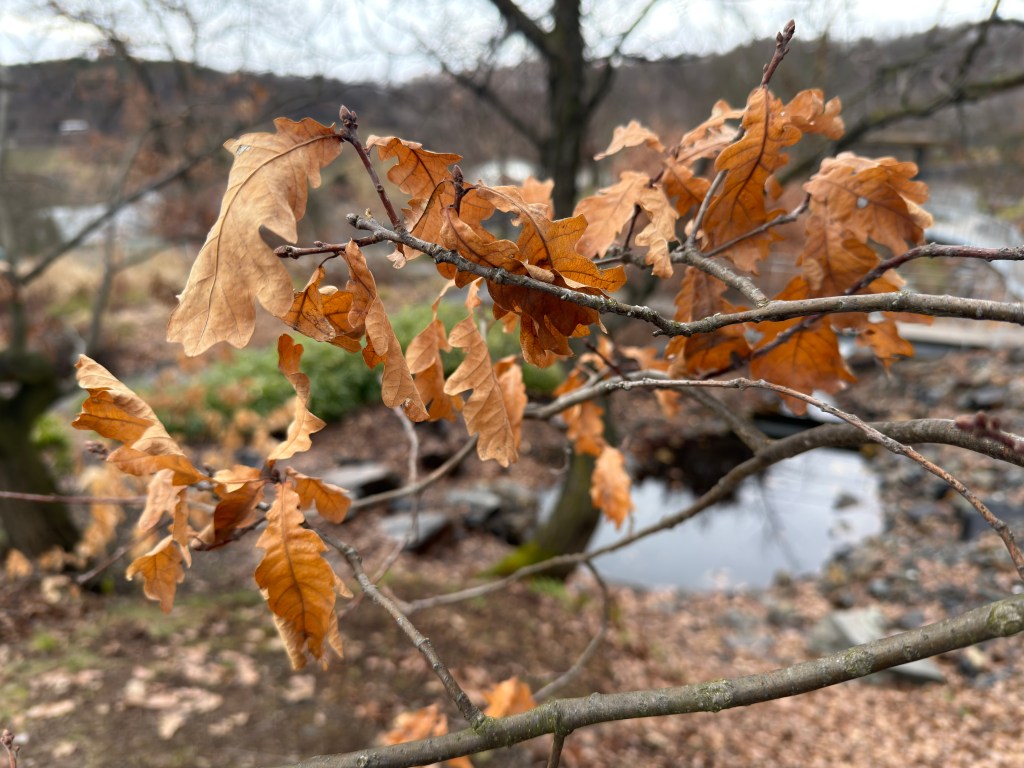
Ecological Information: The Pedunculate Oak is considered a keystone species in Europe, supporting extraordinary insect richness. It is more often found in moist conditions than its congener, Sessile Oak (Q. petraea), though in Czechia it occurs mainly in warmer regions. Its deep roots may help it connect to groundwater. The tree is also highly wind-resistant and can live up to 2,000 years (Prague Botanical Garden sign).
Ecologically, Pedunculate Oak often marks the broader, richer lowland world: Floodplains, valley bottoms, and warm broadleaf landscapes where moisture remains available and where a large, spreading canopy can support complex food webs. It is one of those trees whose importance can be measured not only by its size, but by the number of lives it shelters.
Sociocultural Information: Oaks hold deep historical significance in European culture as symbols of strength, endurance, and life. Large, old oaks are often preserved in village landscapes in Central Europe. In France in the 1980s, Brosse (1987) noted a 750-year-old specimen in the Forêt de Tronçais, and another, with a circumference of 15 m and an age of 1,000 years, at Chapelle d’Allouville-Bellefosse in Normandy.
Oak bark itself is rich in tannins and has long been used to tan hides, as well as in traditional and modern herbal medicine for its astringent properties. The acorns were used to treat diarrhea, dysentery, hemorrhages, fevers, and as a general tonic, including by the Ancient Greeks, Romans, and Gauls (Brosse 1987). They were also used to draw out the venom of snakes and the poison of arrows, and as a poultice for sores (Brosse 1987, Cohen & Siegel 2021). The cambium has been said to be the most potent medicinal part of the tree and was powdered and added to pessaries for abnormal menses (Cohen & Siegel 2021).
In Poland, particularly in Kazimierz on the Wisła River, Oaks have been venerated since ancient times as symbols of strength. Knab (2020) explains that herbal remedies made from dąb bark were used to help people suffering from rheumatism and tuberculosis and to soak wounds. In nearby Ukraine, Ashkenazi herbalists used Pedunculate Oak in similar ways, with a decoction of oak bark, chamomile, and dill applied as a compress for wounds and swollen eyes (Cohen & Siegel 2021). Oak bark was also used to create black and brown dyes for Polish pisanki, or Easter eggs.
Oak galls, formed when cynipid wasps lay their eggs in oak tissue, have also had a variety of historic medicinal uses in Europe. They were used as a source of black hair dye, as an additive to baths for the treatment of a prolapsed uterus, and, when ground, as a treatment for toothaches (Cohen & Siegel 2021).
In more recent traditions, Irish and British folk healers have used a decoction of the bark to treat rheumatism, powdered acorn as a gargle, and decocted leaves to treat ringworm, while Russian folk healers prescribed time in oak forests for relaxation and better sleep (Cohen & Siegel 2021). This is also a valuable timber species, used for structural beams, furniture, and cooperage — that is, barrels for wine and other purposes.
Pedunculate Oak is thus both ecological foundation and cultural elder: a tree of insects and acorns, bark and barrel staves, symbolism and medicine. To learn it is to encounter one of the great broadleaf trees of Europe.
In the posts to come, I’ll continue with other trees that help define Central Europe’s lowland and foothill broadleaf forests, especially Sessile Oak, European Hornbeam, and Little-leaf Linden. Each reveals a different facet of this forest world — dry slopes and rocky soils, layered shade, pollinators and poetry — and together they deepen the story of how trees shape a sense of place.
References
Brosse J. 1987. Les arbres de France: Histoire et légendes. Paris (France): Plon.
Cohen D, Siegel A. 2021. Ashkenazi herbalism: Rediscovering the herbal traditions of Eastern European Jews. Berkeley (CA): North Atlantic Books.
Knab SH. 2020. Polish herbs, flowers, and folk medicine. New York (NY): Hippocrene Books.
Prague Botanical Garden signs. n.d. “Pedunculate oak” and related interpretive signs. Viewed on site February 2026.
 Sense of Place
Leave a comment