In the last several posts, I’ve been moving through the major forest types of Central Europe and some of their characteristic trees. Most recently, I turned to Pedunculate Oak, one of the great broadleaf trees of moister lowlands, floodplains, and warmer broadleaf landscapes. Sessile Oak (Quercus petraea) belongs to that same broadleaf world, but tends to occupy a somewhat different niche. Where Pedunculate Oak suggests moisture, Sessile Oak points toward dry slopes, shallow soils, and the lower uplands. It is a tree of rocky places, mast and timber, and long-managed woodlands.
SESSILE OAK (English), dub zimní (winter oak, Czech), dub zimný (winter oak, Slovak), kocsánytalan tölgy (stalkless oak, Hungarian), Chêne sessile (French)
Quercus petraea, Quercus = beautiful tree (Celtic)/oak (Latin); petraea = of rocky places (Latin)
Identification: The leaves of the Sessile Oak are lobed, lacking the auriculate bases of Pedunculate Oak and extending from a longer petiole. The leaves also often taper into a wedge-shaped form near the petiole. The acorns are on very short stalks and often clustered; they are also known sometimes to germinate on the tree itself (Prague Botanical Garden signs). The bark is similar to that of Pedunculate Oak. The crown of Sessile Oak tends to be more slender and less branched than that of Pedunculate Oak.
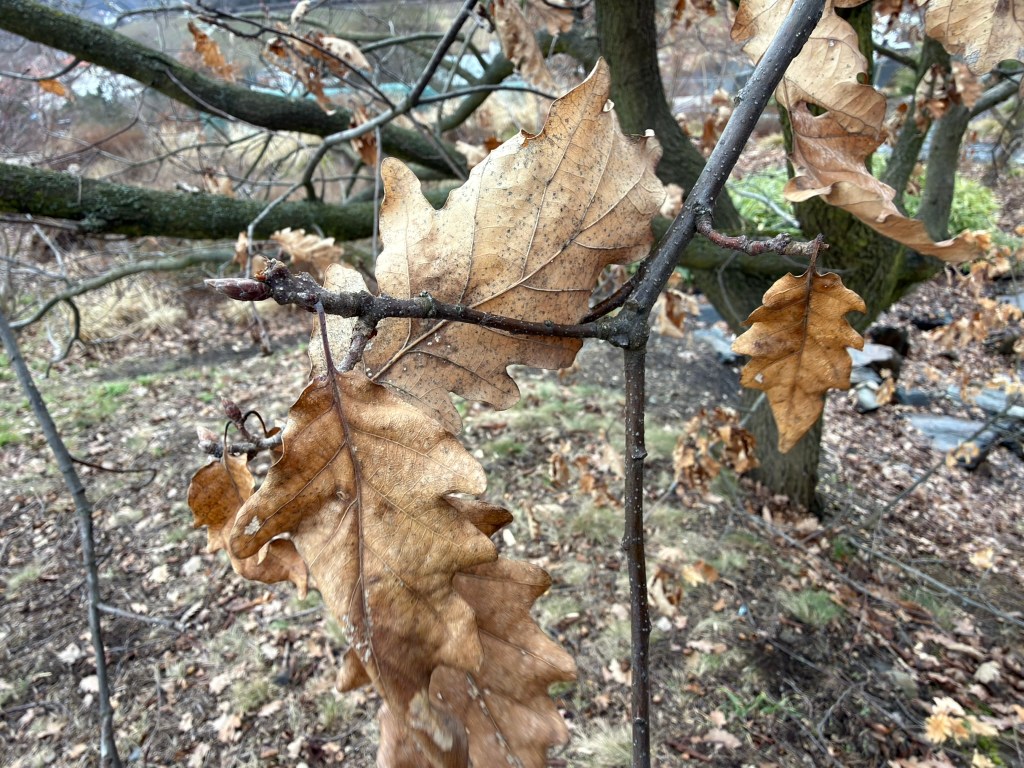
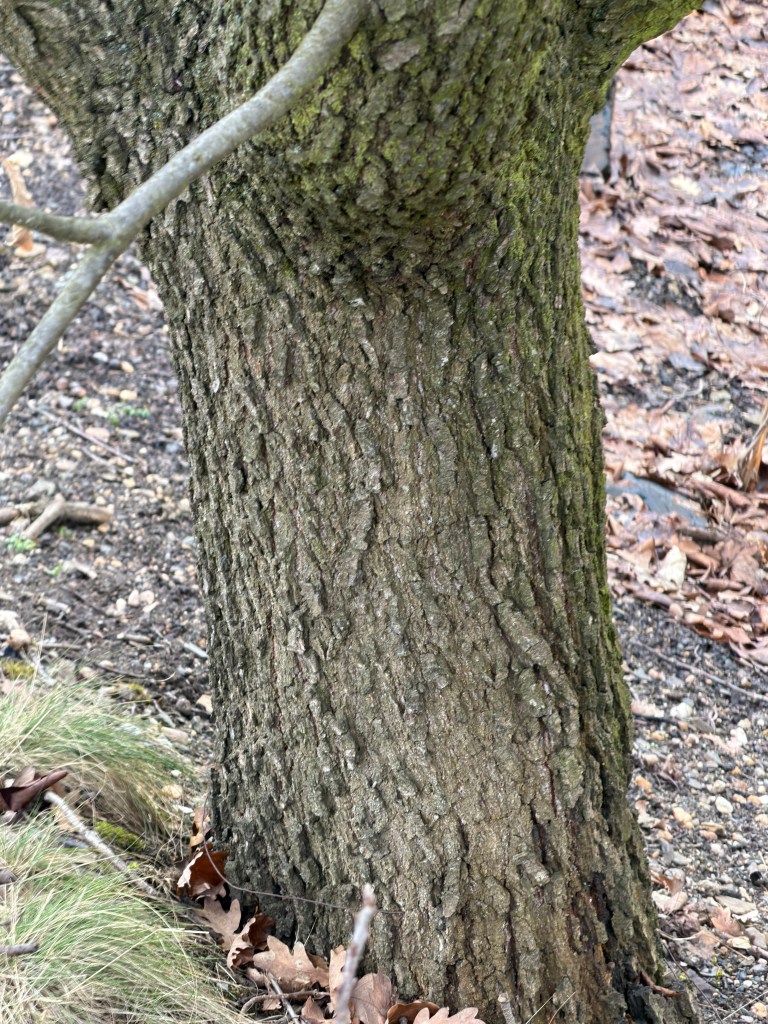
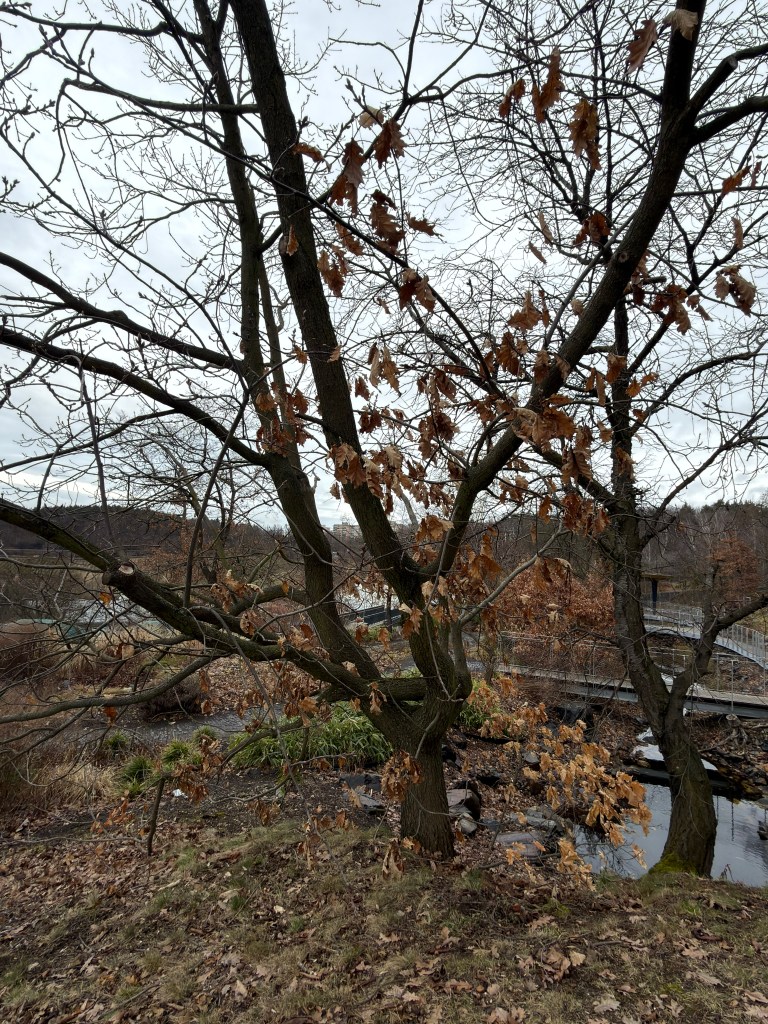
Ecological Information: The Sessile Oak tends to be found on dry, shallow, and rocky soils in Central Europe, often with European Hornbeam, making it more a tree of uplands and low mountains. Sessile Oak helps define a different side of the broadleaf forest world than Pedunculate Oak does. Ecologically, it shows how closely related trees sort themselves across the landscape according to moisture, soil depth, and substrate. It is also an important food source for many wild animals and birds (Prague Botanical Garden sign).
Sociocultural Information: This species has similar uses to Pedunculate Oak, including historical medicinal uses for its astringent and anti-inflammatory properties (Prague Botanical Garden sign). In managed Central European woodlands of the past, foresters often used a two-layer approach called coppice-with-standards. The coppice included trees cut close to the base over long-term cycles, typically 7–30 years, such as European Hornbeam, hazel, and linden, which would resprout and then be used for firewood, poles, charcoal, and other everyday needs. The standards were larger trees left standing to produce timber, mast, and habitat. Sessile Oak would typically be a standard species in these systems.
Oaks also entered the symbolic and artistic language of the region. At the Archdiocesan Museum in Olomouc, for example, a sandstone console with Oak Leaves Decoration, dated to after 1265 and originally from St. Wenceslas Mound in Olomouc, preserves the oak leaf as a carved architectural motif. It is a small reminder that oak was not only a working tree of woodland economies, but also a part of the natural world venerated in stone.
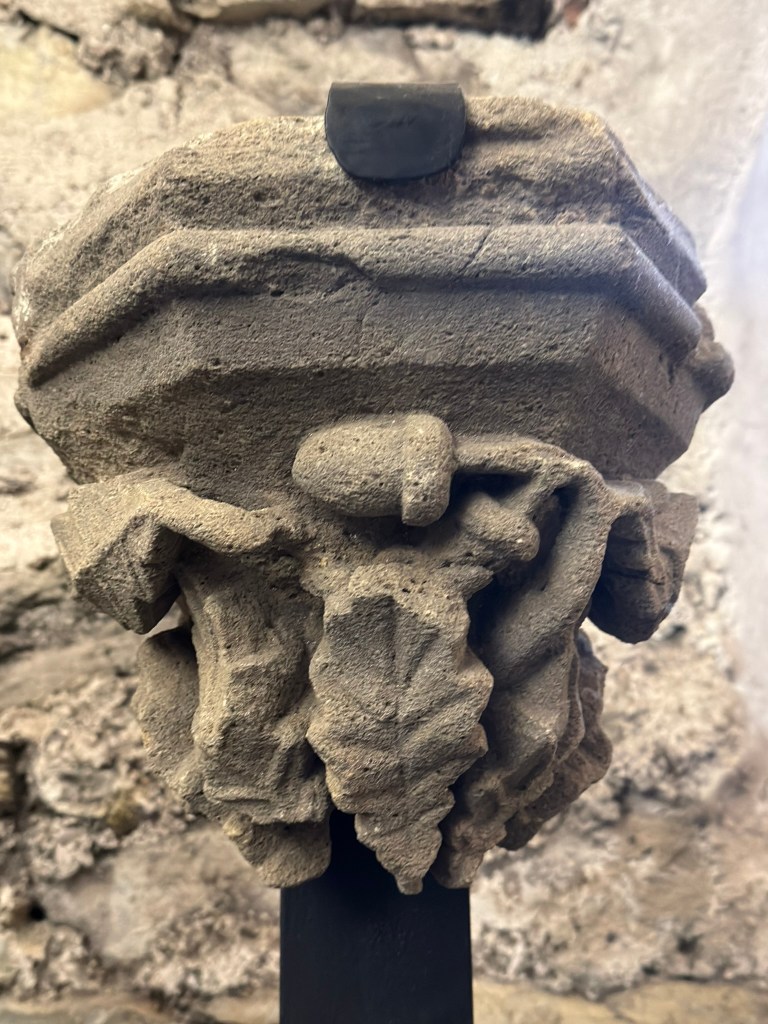
Sessile Oak thus belongs to both ecological and cultural history: a tree of dry slopes and rocky soils, but also of mast, timber, managed woodland systems, and long visual memory. To learn it is to see how a forest tree can be both practical and emblematic.
In the posts to come, I’ll continue with other trees that help define Central Europe’s broadleaf lowlands and foothills, especially European Hornbeam and Little-leaf Linden. Together with the oaks, they create a forest world shaped by slope, soil, and long human use.
References
Prague Botanical Garden signs. n.d. “Sessile oak” and related interpretive signs. Viewed on site February 2026.
Archdiocesan Museum Olomouc sign. n.d. “Console with Oak Leaves Decoration.” Originally from Olomouc, St. Wenceslas Mound. Viewed on site February 2026.
 Sense of Place
Leave a comment