In the last post, I introduced another forested ecosystem in the Central European tree series: the dynamic floodplain forests found along the iconic Danube, Morava, and Tisza Rivers. These systems are home to survivors, plants that stand firm in shifting sands and along muddy banks, including the iconic Black Alder.
BLACK ALDER or EUROPEAN ALDER(English), olše lepkavá (sticky alder oak, Czech), jelša lepkavá (sticky alder, Slovak), mézgás éger (sticky/resinous alder, Hungarian), Aulne glutineux (French), olcha (Polish)
Alnus glutinosa, alnus = alder (Latin); glutinosa = sticky (Latin)
Identification: The Black Alder has a glossy, thick, rounded leaf with a notched tip. Its sticky buds are perched on lenticled twigs. The bark is dark and fissures with age, sometimes taking on a reddish hue. Polish mythology suggests that the red color comes from the blood of the devil, when he was attacked by a wolf that God breathed life into to fight evil (Knab 2020). The most identifiable fruits are persistent, woody cones (female catkins) that hang on through the winter months. The tree is medium in size, but often found in a multi-stemmed form or leaning over streams in wet environments. Brosse (1987) notes that the tree can live up to 300 years.
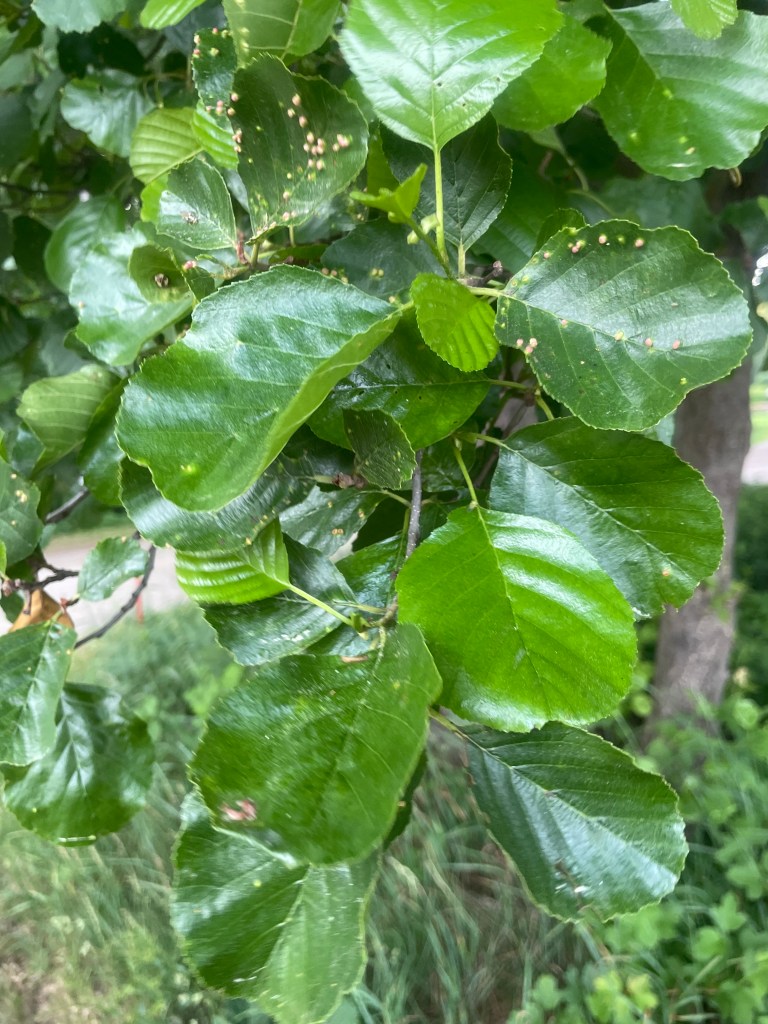
Ecological Information: The Black Alder is a wet-soil specialist found in peaty, biodiverse alder swamps (AKA alder carrs) and along streambanks. It is known for its swollen, rusty-hued root-nodules of nitrogen-fixing Frankia alni, a filamentous symbiotic bacterium, which make Black Alder beneficial in stream bank restoration and help accelerate succession on disturbed, recently flooded land. The roots also stabilize the stream bank and the shade of the canopy maintains cool stream temperatures. These cool streams can serve as refugia for climate-sensitive organisms and low temperature water can hold more oxygen for fish and benthic macroinvertebrates (i.e., the larvae of dragonflies, damselflies, stoneflies, and beyond).
Sociocultural Information: Alder wood holds up underwater, and thus has been used historically for docks and piles, and building in wet environments more generally. According to Brosse (1987), alder has been used to make stilts since antiquity, and supposedly the foundations of Ravenna and half of Venice was built of alder. While the In keeping with this ecology, in symbolic material, Black Alder is associated with water and renewing flow (Bartha 1999; Hrušková et al. 2017).
Black Alder produces at least three different dyes, green from the flowers, brown from the branches, and red from the bark. These are said to represent water, earth and fire. It has been used medicinally in Poland to treat wounds and to soothe breasts engorged with milk (Knab 2020).
It is also used for fuel and to smoke foods regionally; and Brosse (1987) says that the wood is almost smokeless and that the charcoal of this species gives off good heat compared to other species. In keeping with this use, Brosse (1987) shares that according to the people of ancient Argos (think modern day Peloponnese) the Alder is associated with Phoroneus, a man known as the “fire bringer”.
Knab (2020) shares a verse featuring alders from Władysław Stanisław Reymont’s (1867–1925) four-part novel The Peasants: “The meadows were veiled in a low creeping haze, through which tufts of alders peered out like puffs of dark smoke.” The brilliance of this line is that Reymont describes the atmosphere of the alders in situ along a meadow edge, but hints at the deeper cultural significance of the tree. Reymont won the 1924 Nobel Prize in Literature in large part for this work which explores village-life in late 19th-century Poland.
In the next post, I’ll explore another important floodplain species in Central Europe: The Black Poplar. Symbolically, Black Alder is red and fiery, and Black Poplar is its foil, useful in its own right, and associated with tears and fears.
References
Bartha, D. (1999). Magyarország fa- és cserjefajai. Mezőgazda Publishing House.
Brosse, J. (1987). Les arbres de France: Histoire et légendes. Plon.
Hrušková, M., Větvička, V., & kolektiv autorů. (2017). Život se stromy. Dokořán.
Knab, S. H. (2020). Polish herbs, flowers, and folk medicine. Hippocrene Books.
 Sense of Place
Leave a comment