In the last several posts, I’ve been moving through the major forested worlds of Central Europe, from mountain forests of Spruce, Fir, Beech, and Larch, to the Broadleaf Forests of the lowlands and foothills, and most recently to the shifting floodplain forests of the Danube, Morava, and Tisza. Here, I turn to a different kind of forested landscape: the dry woodlands and steppe-edge habitats of Central Europe. These are places of ecological contrast, where forests mix with grasslands, shrubs, and rocky slopes, and where geology shapes plant communities as strongly as climate.
Dry, Nutrient-poor Sites. Dry, nutrient-poor sites occur on the Pannonian Plain, especially in Hungary, and in other dry or disturbed sites across Slovakia and the Czech Republic. These habitats often include dry river terraces or early-successional sites recently disturbed by fire, windthrow, or land clearing. They are frequently underlain by glacial loess or alluvial sand, which create fast-draining, nutrient-poor soils.
These dry habitats are not limited to the more familiar sandy Pine-Birch systems. In Czechia, rocky steppe and calcareous slope mosaics support open, species-rich vegetation shaped by permeable, relatively nutrient-poor substrates and by older grazing regimes. In the Lower Vltava region, geological diversity — including hard shales, veins of other rocks, and slightly calcareous loess — creates a remarkable variety of habitats. Many of these sites now require shrub cutting or grazing to prevent overgrowth (Prague Botanical Garden signs, “Troja Steppe”; “Rocks of the Lower Vltava Valley”; “Archa Bohemica”). In Hungary, comparable dry woods include Turkey Oak–Sessile Oak forests, sandy Oak woods, rocky woods, and forest-steppe woods.
In the warmer and drier parts of Central Europe, especially in parts of Hungary and in rocky lowland-to-upland sites around Prague and the Lower Vltava, dry woodlands often occur as mosaics with steppe grasslands and shrublands. These systems are strongly structured by substrate. Limestone, basalt, marlstone, serpentinite, slate, loess, and sandy patches can all occur in close proximity, creating unusually high local habitat diversity. These landscapes are often conservation-dependent, requiring grazing, cutting, or shrub removal to prevent overgrowth.
Some dry woodland systems in Czechia also support highly localized woody endemics. One example is Sorbus omissa, a critically endangered rowan described in 2012 and known from only two small localities on the left bank of the Vltava. It grows mainly in light oak woods on calcareous rocky slopes (Prague Botanical Garden signs, “Sorbus omissa”).
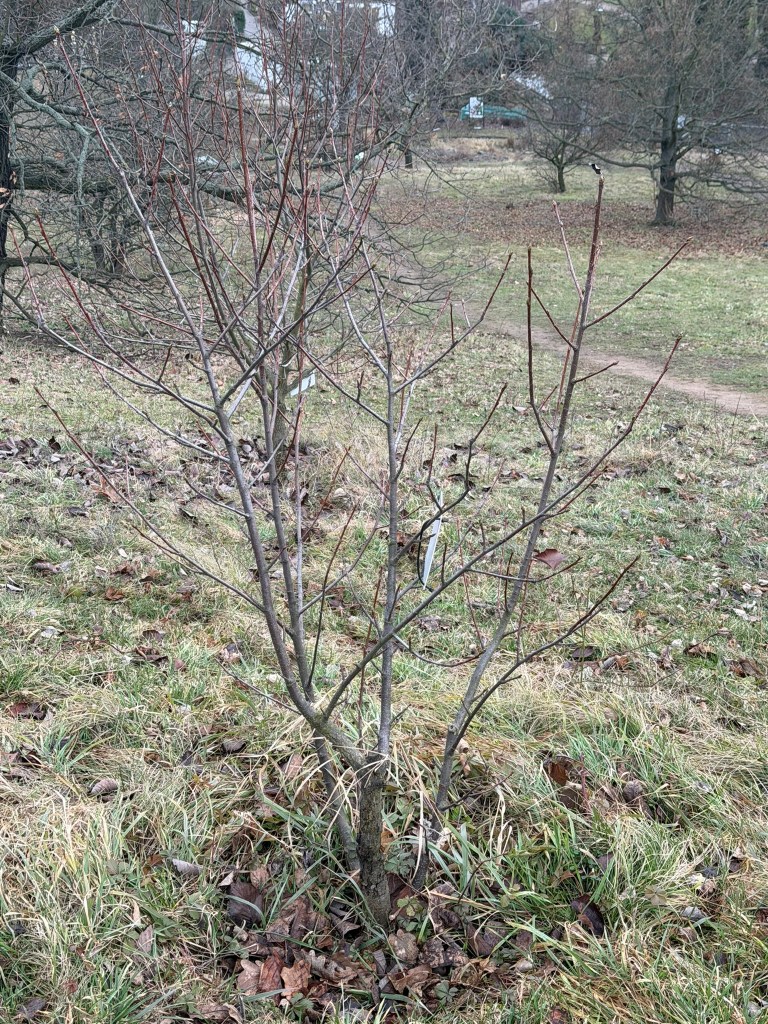
Key trees of this habitat include Scots Pine (Pinus sylvestris) and Silver Birch (Betula pendula), which will be the subjects of future posts. Other woody plants that can be found in these habitats include:
- Turkey Oak (Quercus cerris)
- Field Maple (Acer campestre)
- Sweet Chestnut (Castanea sativa)
- Oriental Hornbeam (Carpinus orientalis)
- Garland Flower (Daphne cneorum)
- Feather Grass (Stipa spp.)
- Heather (Calluna vulgaris)
- Lingonberry (Vaccinium vitis-idaea)
These dry woodlands reveal another side of Central Europe: one shaped by exposure and light, substrate and disturbance. They are habitats of ecosystem edges (i.e., ecotones) and mosaics, where forest is often patchy, transitional, and inseparable from surrounding grassland and shrubland. Understanding these systems provides an opportunity to see how trees respond to stone and soil depth, along with long histories of human use.
In the posts to come, I’ll take a closer look at some of the characteristic species of this dry woodland world, including Scots Pine and Silver Birch, two trees that thrive where soils are poor, light is abundant, and disturbance opens new ground.
References
Bartha, D. (1999). Magyarország fa- és cserjefajai. Mezőgazda Publishing House.
Prague Botanical Garden signs. (n.d.). Troja Steppe, Rocks of the Lower Vltava Valley, Archa Bohemica, Sorbus omissa, and related interpretive signs. [Viewed on site February 2026].
 Sense of Place
Leave a comment