by Nicolette L. Cagle, Ph.D., April 13, 2026
In the last post, I explored the dry woodlands and steppe-edge habitats of Central Europe, where thin soils, lots of light, and anthropogenic disturbance create a different world from the cool mountain forests, broadleaf lowlands, and floodplains that came before. Here, I turn to one of the characteristic trees of that drier world: Scots Pine (Pinus sylvestris). Hardy, light-loving, and tolerant of poor soils, Scots Pine is one of the trees that helps hold open-canopied, nutrient-poor habitats together.
SCOTS PINE (English), borovice lesní (forest pine, Czech), borovica lesná (forest pine, Slovak), erdei fenyő (forest pine, Hungarian), Pin sylvestre (French)
Pinus sylvestris, pinus = pine (Latin); sylvestris = of the forest (Latin)
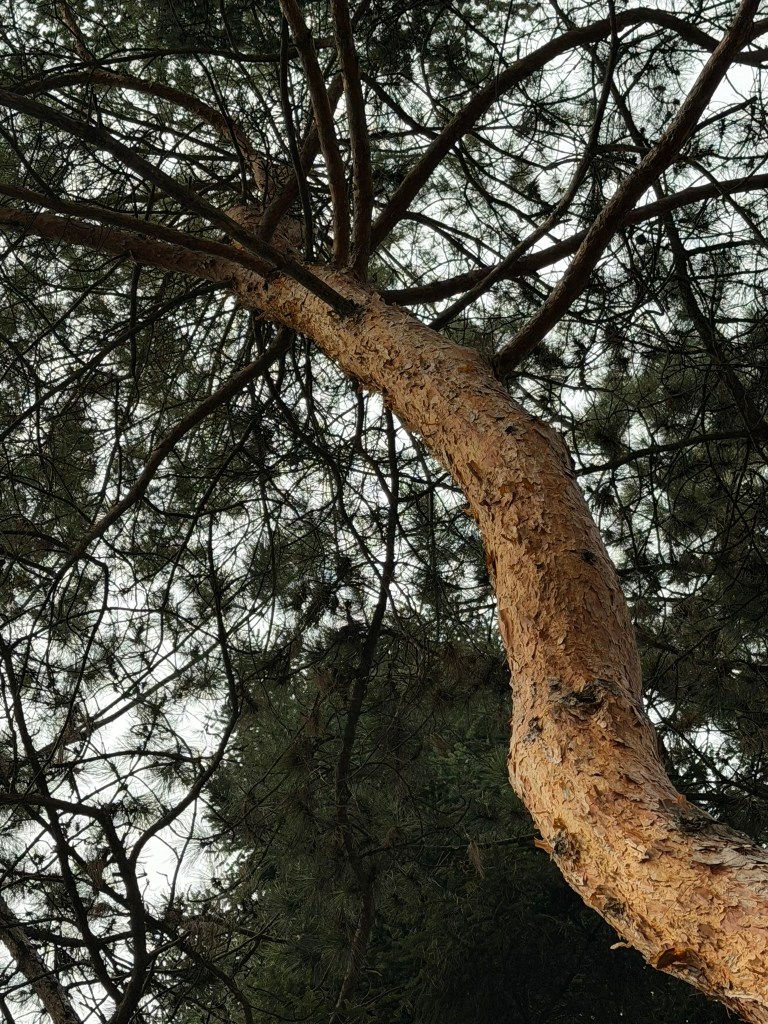
Identification: This 40–50 m tall pine has two needles per fascicle (bundle), often slightly twisted and blue-green in color. The bark is highly recognizable, with orange-red plates on the upper trunk and darker gray-brown blocks lower down. The cones are small and egg-shaped; male cones are sulfur-yellow and female cones pink-red. Cones ripen every two to three years. This is a medium-large tree, with an irregular crown when grown in the open, and it can live 300 to 500 years.
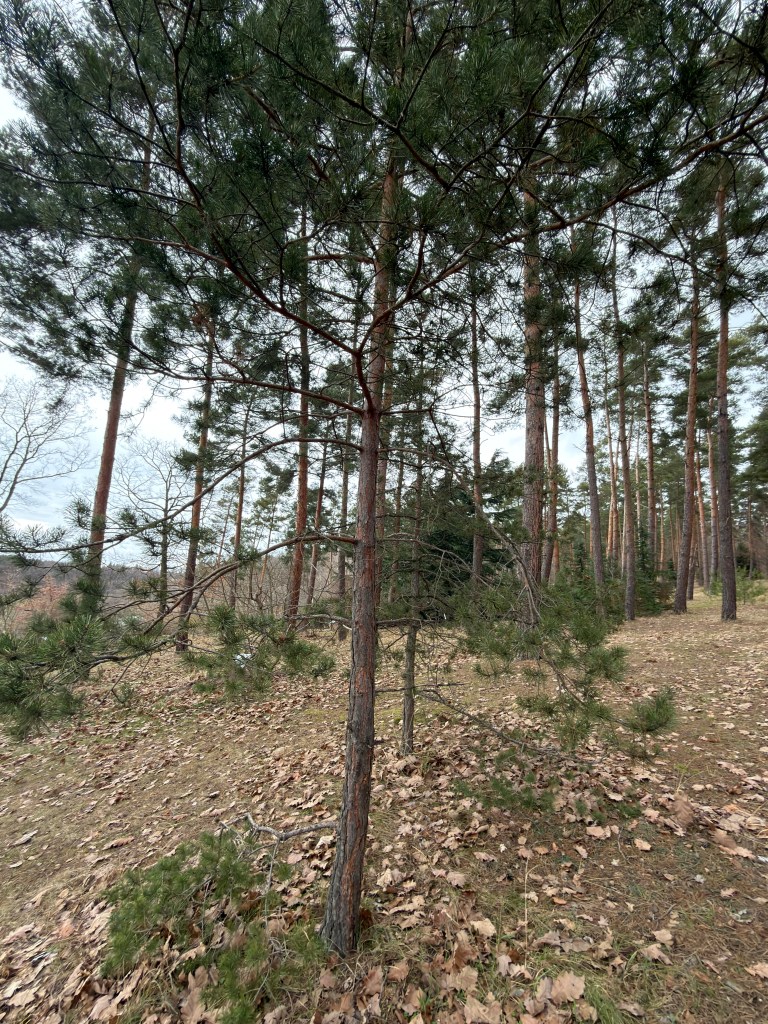
Ecological Information: Scots Pine is very hardy on poor soils and tolerant of both frost and drought. It mixes with a variety of species, including oaks, beech, birch, and other conifers. It is especially at home in dry, sandy, acidic, or otherwise nutrient-poor sites where other trees may struggle. In that sense, it helps define woodlands shaped by exposure, disturbance, and low fertility rather than by deep shade or rich soils.
Other native pines do occur in the region, including Mountain Pine and Bog Pine, particularly within the Czech flora (Prague Botanical Garden signs, “Scots pine”).
Sociocultural Information: This is a major timber species, and its resin and needles have long been used in traditional medicine, especially for respiratory purposes, often in ways similar to spruce and fir. According to the Prague Botanical Garden, Scots Pine is also one of the most suitable woods for shipbuilding.
Scots Pine is thus both ecologically tough and culturally useful: a tree of poor soils and exposed ground, exploited for its timber and beloved for its practical endurance. In the dry woodlands of Central Europe, it helps show how forests persist where conditions are tough and the light is almost too bright.
In the next post, I’ll turn to Silver Birch, another characteristic tree of these dry and disturbed landscapes. If Scots Pine is orange-barked, resinous. and enduring, Silver Birch is pale, papery, and quick to arrive where ground has been opened.
References
Prague Botanical Garden signs. (n.d.). Scots pine and related interpretive signs. [Viewed on site February 2026].
 Sense of Place
Leave a comment