by Nicolette L. Cagle, Ph.D., April 13, 2026
In the last several posts, I’ve explored the dry woodlands and steppe-edge habitats of Central Europe, where trees grow in bright light and on poor soils impacted by disturbance. After turning to Scots Pine, I arrive at another characteristic species of these transitional places: Silver Birch (Betula pendula). If Scots Pine is a hardy conifer of poor ground, Silver Birch is often one of the first broadleaf trees to arrive where soil has been exposed or disturbed.
SILVER BIRCH (English), bříza bělokorá (white-barked birch, Czech), breza previsnutá (drooping birch, Slovak), bibircses nyír (warty birch, Hungarian), Bouleau verruqueux (French)
Betula pendula, betula = birch (Latin); pendula = hanging (Latin)
Identification: Silver Birch has a small, triangular to diamond-shaped leaf with a pointed tip and serrated edges. The bark is white and peels in papery layers, while the bases of older trees become darker and rougher with time. The twigs are slender, drooping, and marked by resinous warts, hence the Hungarian common name. The flowers are catkins and the fruits are tiny winged seeds. The tree reaches about 20–25 m, with an open, airy crown, and lives at most about 100 years (Brosse, 1987).
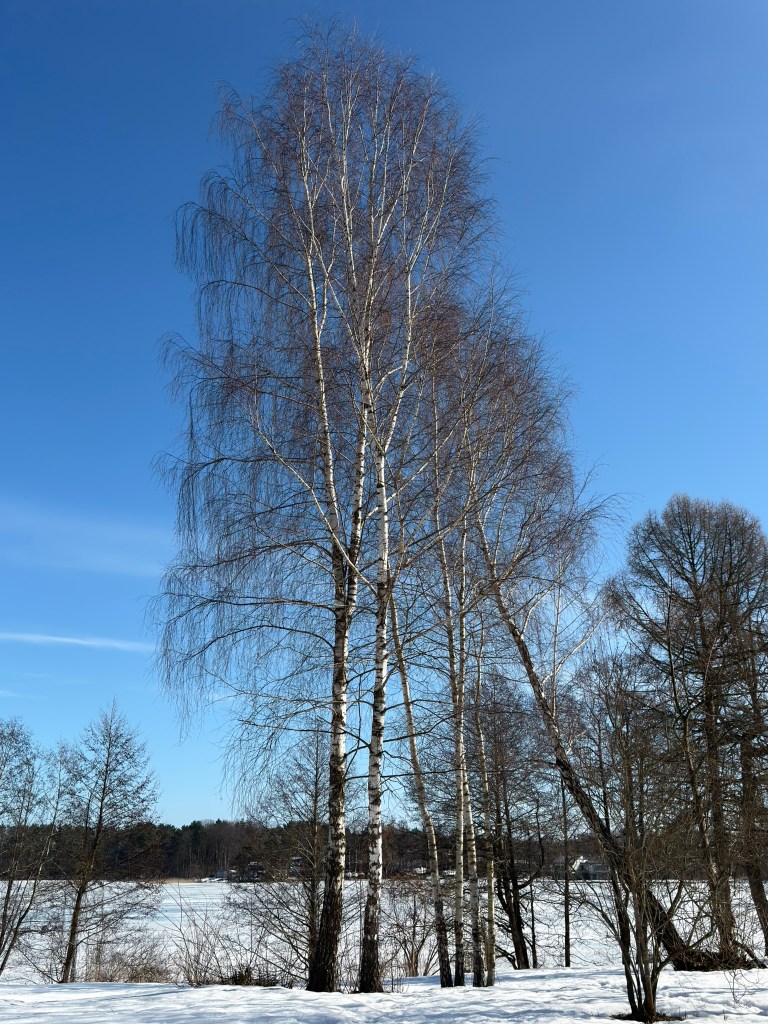
Ecological Information: Silver Birch is often seen at forest edges and in disturbed areas. It colonizes disturbed ground quickly, including acidic, sandy, and burned sites. It also supports a variety of fungal and invertebrate species. The species is known to handle cold well, with congeners in Greenland, Iceland, and Siberia becoming dwarfed and shrubby (Brosse, 1987).
Ecologically, Silver Birch is a tree that marks disturbance. It is often among the first to green up a damaged or open place, and its pale bark and airy crown give otherwise heavy, denuded landscapes a sense of lightness. Thus, it is both a pioneer and a signal that succession is underway.
Sociocultural Information: According to Jacques Brosse (1987), the birch tree has been an important sociocultural species since Neolithic times, when birch tar was used to fill holes and cracks. The fresh wood of spring was historically used to make paper, sandals, and waterproof boats (pirogues); older wood was used to cover cabins and make ropes, nets, and even cups; and the branches were used to make baskets and brooms.
Silver Birch has had a wide range of ethnobotanical uses in Europe, including in beverages, topical remedies, and folk medicine. In Poland, the sap (oskoła, sok brzozowy) was used to cleanse the blood and encourage hair growth, while the syrup was used for general health. Elsewhere, the sap was used to treat arthritis and urinary problems and to make candies, sparkling wine, and vinegar. The bark was used as a diuretic and fever reducer, as well as to treat skin problems and stimulate digestion. The buds were used to increase bile secretion, while young leaves treated gout.
Even today, people use birch branches to strike the skin in Scandinavian saunas and Russian steam baths, continuing a tradition associated with purification and renewal. Brosse (1987) also links this to much older ritual traditions, including Siberian shamanic uses of birch as a tree connected to the spirit world.
Birches are also deeply tied to spring in European traditions. In Scandinavia, the leafing out of birch once signaled planting time. In Sweden, bouquets of birch branches were gathered to represent hopes for good weather, abundant harvests, and other blessings. Old Russian customs included cutting a birch the Thursday after Pentecost, dressing it up, visiting it over several days, and eventually tossing it in a river, probably to ensure good rains for the planting season. In Poland, birch branches were used around Pentecost to decorate homes and altars.
Even today, I recall my Polish-American mom loving the birch tree that grew in front of our house in Chicagoland. When it died, she kept sections of large branches on the hearth, and she even transported them to my parents’ home late in life, where one hunk of birch still sits on the hearth today.
With Silver Birch, this Central Europe Sense of Place tree series comes, for now, to a close. But more posts are on the way. In the months ahead, I hope to turn toward the forested and semi-forested worlds of Southeastern Europe — especially Romania, Bulgaria, Serbia, and North Macedonia — as well as the trees and landscapes of China and Mongolia. I also plan to return to a very different kind of natural history closer to home: the ecology of the Eastern Box Turtle in North America and beyond. If these Central European trees have been one way of learning how read and contect to place, the next posts will continue that effort across new regions, species, and scales.
References
Brosse, J. (1987). Les arbres de France: Histoire et légendes. Plon.
 Sense of Place
Leave a comment