by Nicolette L. Cagle, Ph.D., May 26, 2026
In the last post, we began a new part of this Eastern Box Turtle series by considering the turtle’s gifts. In Western science, many of these gifts are described as ecosystem services, or the useful work a species does in a larger ecological system. That language can be helpful when we need to make ecology visible, but it can also make the living world feel transactional. Following Robin Wall Kimmerer’s invitation in The Serviceberry, I want to continue using the language of gifts because it foregrounds an ethos of relationship and reciprocity (Kimmerer, 2024).
We begin with one of the clearest gifts: the seeds and spores carried through the turtle’s body.
Eastern Box Turtles eat close to the ground. They find fallen fruits, mushrooms, invertebrates, and other foods within the low, humid world of leaf litter and decay. Then they move on. Not quickly, and not very far compared with a bird or a deer, but an ecologically meaningful distance nevertheless. A turtle that eats in one place in the forest may defecate somewhere else, depositing seeds, fungal spores, and the possibility of new growth.
The Mayapple (Podophyllum peltatum) offers one of the best examples of the gift of dispersal. Mayapples are a spring ephemeral in eastern deciduous forests, a clonal, rhizomatous plant whose umbrella-like leaves unfurl early before the leaves of the forest canopy unfold and fully close (Rust and Roth, 1981). The flowering stem of Mayapples usually fork into two parasol leaves, with a single white flower tucked into the fork, hidden beneath the foliage. Later, if pollination and fruit development succeed, the plant produces a fleshy fruit from the flower.
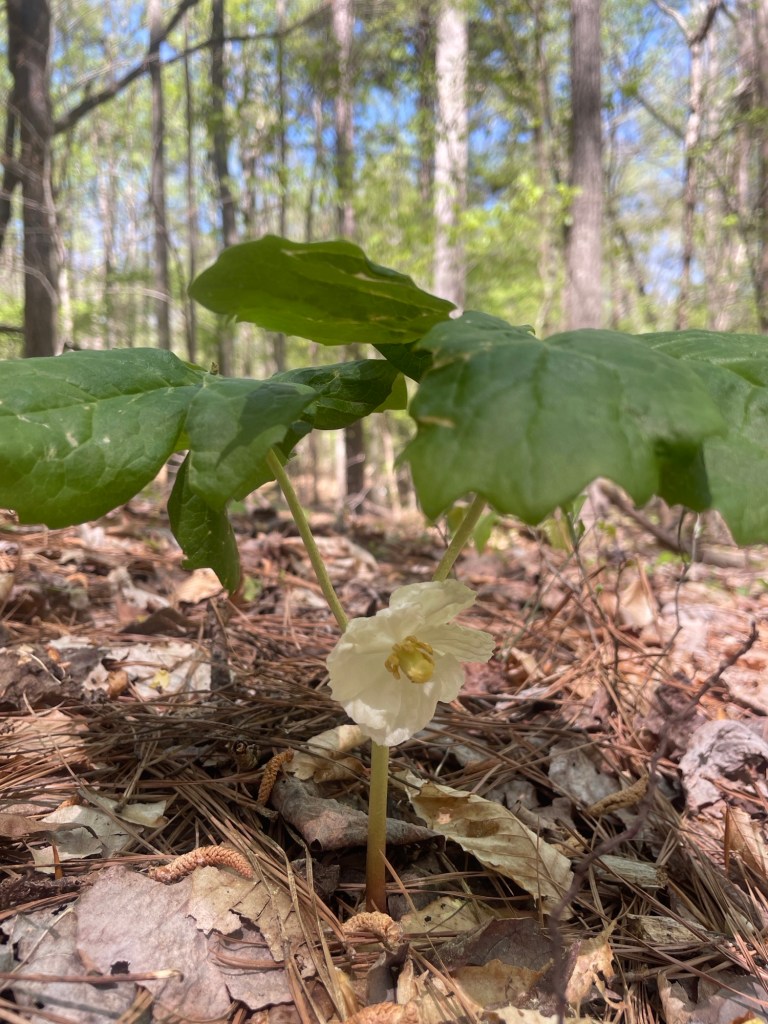
Mayapples are also a species that signal caution. Most of the plant is poisonous, including the leaves, roots, and unripe fruit. The fully ripe fruit is the exception, and even that has traditionally been eaten with care. Cornell Botanic Gardens notes that Cherokee, Chippewa, Haudenosaunee, Menominee, and Meskwaki people ate ripe Mayapple fruit fresh or dried, while multiple Indigenous groups also recognized and used the plant’s stronger medicinal or toxic properties (Cornell Botanic Gardens, n.d.). This combination of beauty, food, and medicine, balanced on the razor-edge of toxicity, makes Mayapples a good reminder that ecological relationships are complex: a fruit that is dangerous at one stage may become food at another; a plant that is defended from herbivory by toxins may invite dispersal when the time is right.
Eastern Box Turtles respond to the Mayapple’s invitation. Rust and Roth (1981) found that Eastern Box Turtles were the only seed-dispersal agents they could identify for Mayapples in their study. Moreover, box turtle-ingested Mayapple seeds germinated faster and had a higher probability of success than seeds that had not passed through the turtles’ digestive tracts. In other words, the turtle did not simply eat the fruit and carry the seeds. Passage through the turtles’ digestive systems enhanced the seed’s prospects.
One reason this can happen is scarification. Scarification means the weakening, scratching, or wearing down of a seed coat so that water and oxygen can enter the seed more easily and germination can begin. In nature, scarification happens through alternating cycles of freezing and thawing, abrasion in soil, the heat of a ground fire, or passage through an animal’s digestive tract. In a turtle’s gut, seeds may be separated from fruit pulp, exposed to digestive acids and enzymes, and gently abraded as they move through the digestive system. The result depends on the plant species, but some seeds definitely benefit. For the Mayapple, the turtle’s digestive journey is a reproductive boon.
While the seed moves through the turtles gut, the turtle moves through the forest. That journey moves the Mayapple seed away from the parent clone. This matters because Mayapples typically spread clonally through rhizomes, and seedlings that remain close to dense parent patches face competition, predation, and poor establishment conditions. Rust and Roth found that when Mayapple fruits and seeds weren’t removed from the clone area, it resulted in major losses between flowering and seedling establishment (Rust and Roth, 1981). An Eastern Box Turtle with a Mayapple fruit in its gut, moving across the forest floor, can change that.
Other Eastern Box Turtle and plant studies widen the view. Braun and Brooks (1987) found that seeds from many plant species germinated after passing through Eastern Box Turtles, including Mayapples, Jack-in-the-pulpit, Pokeweed, Black Cherry, and Summer Grape. Jordan (2004) found seeds in Eastern Box Turtle fecal samples, including blackberry, Black Cherry, and wild strawberry. Stone and Moll (2009), studying Eastern Box Turtles (Terrapene carolina) and Ornate Box Turtles (T. ornata) in Missouri, recovered seeds from at least 17 plant taxa in turtle feces, including mulberry, blackberry, grape, Mayapple, pokeweed, passionflower, sycamore, and others. They found that T. carolina feces contained greater seed-species richness than T. ornata, likely reflecting differences in habitat use, fruit availability, or foraging behavior.
As we interpret these studies, it is important to remember that finding seeds in box turtle feces tells us that turtles have the potential to disperse those plants; it does not prove that every seed survives, germinates, and establishes. Stone and Moll (2009) make this point directly, noting that seed survival through the digestive tract and the effects of gut passage can vary by plant species. But even with that caution, the pattern is clear: Eastern Box Turtles eat fruits and pass seeds, and for some plants, that passage supports germination and movement through the forest.
While a box turtle is not a windstorm, a migrating bird, or a deer carrying seeds across miles of habitat, its more humble gift of dispersal connects the places a turtle knows best, including damp hollows, patches of brambles, and the forest interior. In fragmented landscapes, this kind of movement matters even more. Furthermore, the distance between two habitat patches does not have to be large for dispersal to be ecologically meaningful. Sometimes the important journey is from beneath the dense shade of a parent plant’s leaves to a patch of light.
As Eastern Box Turtles feed and forage, they might be doing double dispersal duty. A box turtle carrying plant seeds in its gut may also carry fungal spores. Eastern Box Turtles love to eat fungi, and recent diet work in the Long Island Pine Barrens found mushroom material in a substantial portion of fecal samples (Figueras et al., 2021). Jones and colleagues (2007) described the Eastern Box Turtle as a facultative mycovore, meaning that it eats fungi but is not dependent on fungi alone. In their study, fecal samples from 36 turtles yielded 23 fungal taxa, including Zygomycota, Ascomycota, and Basidiomycota, and the authors suggested that turtles may influence fungal spore dispersal within their home ranges.
The specific fungal taxa found in feces are not necessarily all the same as the mushrooms we easily notice on the forest floor. Jones et al. (2007) isolated many microfungi and yeasts, including taxa such as Cryptococcus albidus, Rhodotorula mucilaginosa, and Aspergillus wentii. These are not the charismatic mushrooms most of us point to on a walk, but they are part of the broader fungal world that decomposes organic matter, lives on plant material, and participates in nutrient cycling. The larger point is that while box turtles can disperse showy mushrooms, they also do the important work of dispersing under-appreciated species that do a great deal of ecological work in their own right.
In fact, fungi are central to forest function. Some fungi decompose wood and leaf litter. Some live in association with plant roots. Some are pathogens. Some are food. Some are all but invisible without a microscope. A turtle eating fungi or plant material, then depositing spores elsewhere, participates in that less visible layer of forest life, becoming part of the dynamic dispersal of seed and spore.
This is where the gift becomes more than a simple service. When we say that box turtles disperse seeds and spores, we are sharing only part of an ecological truth. The fuller truth is relational. Mayapples’ fruit becomes turtle food. Turtle digestion expands a seed’s possibilities. Turtle movement changes location. Feces become a dense packet of nutrients. A new plant may grow in the turtle’s wake. Fungal spores may arrive in a new patch of leaf litter. The forest is not just a matrix around an Eastern Box Turtle; integral parts of the forest itself are held within the turtle.
Importantly, for us humans to receive this gift from the more-than-human world well, we have to protect the conditions that make it possible. Seed and spore dispersal require box turtles that are wild and free to move safely through connected habitat mosaics. Roads interrupt that movement. Poaching for the pet trade removes box turtles from landscapes where their ecological work is needed. Fragmentation reduces the chance that a box turtle’s grounded dispersal can connect one patch of habitat to another.
Reciprocity is not abstract. It means leaving wild box turtles in their home landscapes. It means helping a box turtle cross a road safely in the direction it was already traveling. It means protecting leaf litter, spring ephemerals, coarse woody debris, damp hollows, and passages between habitat patches. It means noticing that a Mayapple patch, a mushroom, and a box turtle are not separate entities, but participants in a shared system.
In the next post, we will widen the view from seeds and spores to the Eastern Box Turtle’s broader role in the forest-floor food web, as an omnivore moving through fruits and fungi, invertebrates and carrion, and leaf litter and soil.
References
Braun J, Brooks GR Jr. 1987. Box turtles (Terrapene carolina) as potential agents for seed dispersal. American Midland Naturalist. 117(2):312–318.
Cornell Botanic Gardens. n.d. Mayapple. Cornell University. Accessed 2026 May 25.
Figueras MP, Green TM, Burke RL. 2021. Consumption patterns of a generalist omnivore: Eastern Box Turtle diets in the Long Island Pine Barrens. Diversity. 13:345. https://doi.org/10.3390/d13080345
Jones SC, Jordan WJ IV, Meiners SJ, Miller AN, Methven AS. 2007. Fungal spore dispersal by the Eastern Box Turtle (Terrapene carolina carolina). American Midland Naturalist. 157(1):121–126.
Jordan WJ IV. 2004. Eastern Box Turtle (Terrapene c. carolina) as a dispersal vector of seeds and spores [master’s thesis]. Charleston (IL): Eastern Illinois University.
Kimmerer RW. 2024. The Serviceberry: Abundance and Reciprocity in the Natural World. New York (NY): Scribner.
Rust RW, Roth RR. 1981. Seed production and seedling establishment in the Mayapple, Podophyllum peltatum L. American Midland Naturalist. 105(1):51–60.
Stone PA, Moll D. 2009. Abundance and diversity of seeds in digestive tracts of Terrapene carolina and T. ornata in southwestern Missouri. Southwestern Naturalist. 54(3):346–350.
 Sense of Place
Leave a comment